
Keeneland September 2026 · Book 1, Session 2
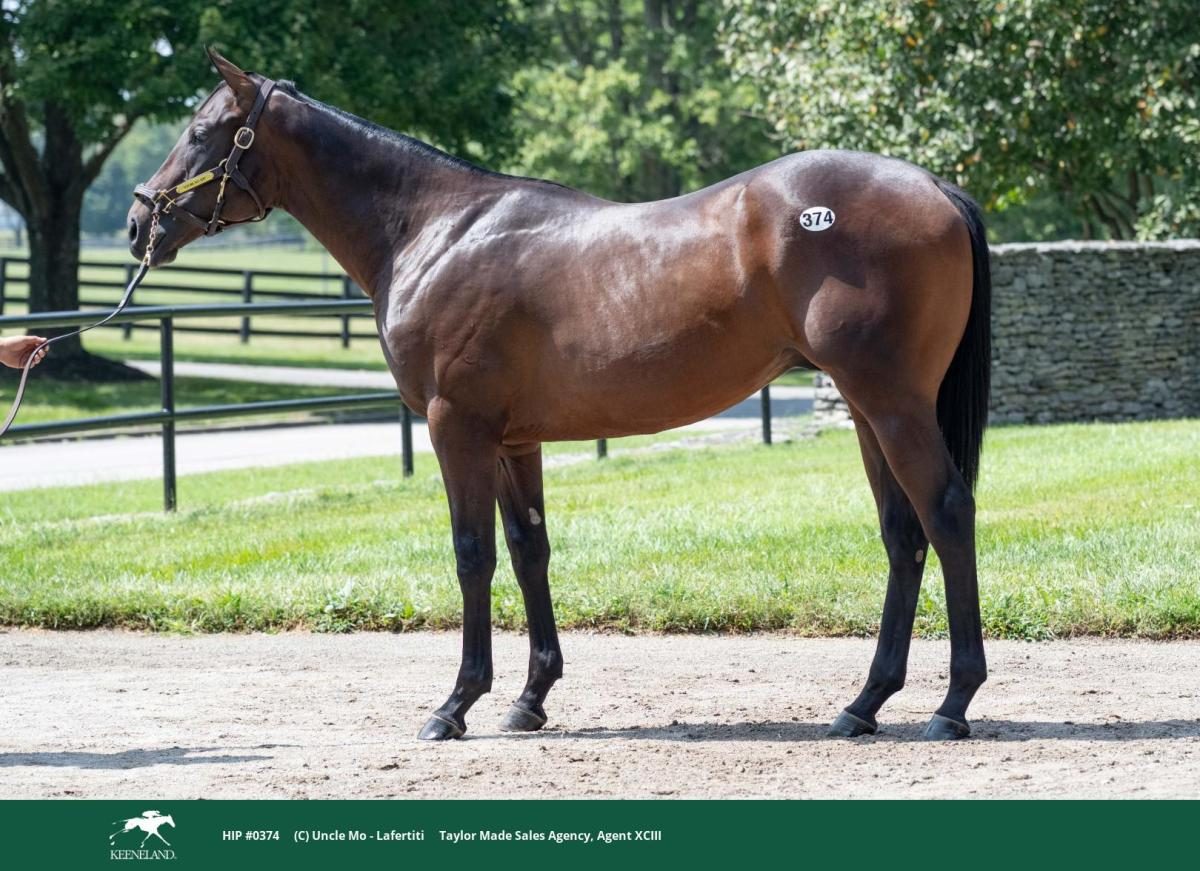
Hip 374Uncle Mo – Lafertiti
Bay colt, foaled March 9, 2025, by Uncle Mo out of Lafertiti, by Pioneerof the Nile. Consigned by Taylor Made Sales Agency, Agent XCIII.
Prepared by Thoroughbred Intelligence
September 15, 2026 · Reference TI-KEESEP26-H374
This memo includes a video walkthrough, available in the web version at the link supplied with this document.
Lot Identification
- Hip
- 374
- Sale
- Keeneland September 2026, Book 1, Session 2
- Barn
- 9
- Consignor
- Taylor Made Sales Agency, Agent XCIII
- Sex
- Colt
- Foaled
- March 9, 2025
- Sire
- Uncle Mo
- 1st Dam
- Lafertiti
- Dam Sire
- Pioneerof the Nile
- 2nd Dam
- Laffina, by Arch
- Maternal Family
- Bast, Fault, Mananan McLir, Big Sur
- Dam Status
- Unraced
- Produce Status
- First foal
Scope. This assessment is based on the supplied catalog and family-performance records. The available materials do not provide the direct mating datasets, nick reports or detailed sire-production statistics used in some Thoroughbred Intelligence profiles. Those inputs are therefore treated as unknown rather than inferred. Physical, cardiovascular and veterinary findings are outside the present analysis.
Executive Racing Read
This colt profiles as a high-class dirt prospect with strong juvenile credentials, genuine two-turn potential and a particularly attractive two-to-three-year-old developmental profile.
The first dam supplies no racing evidence and no prior produce evidence. Lafertiti was unraced and this is her first foal. That creates uncertainty, but the immediate family around her is unusually informative. Her dam Laffina produced Bast, a three-time Grade 1 winner at two by Uncle Mo, giving this colt exceptionally close evidence that Uncle Mo works with this specific female family.
That distinction is important. This is not the exact mating that produced Bast. Bast is out of Laffina, while the subject is out of Laffina's daughter Lafertiti. Still, Bast gives us a three-quarter-relative-type family relationship built around the same sire and maternal branch, and her racing profile is highly relevant: four wins from six starts, three Grade 1 victories at two, a Grade 2 win at three and a Breeders' Cup Juvenile Fillies [G1] placing.
The deeper family adds something different: repeated evidence of horses who race, develop and stay in training. Fault won six races and a Grade 1 at four. Mananan McLir made a long career through age nine. South Bend earned more than $750,000. Betweenhereandcool won 23 races. Pendulum won 18.
The preferred racing model is useful to potentially high-class at two, with the pedigree to carry that ability into two-turn dirt racing at three. The mature center is approximately one mile to 1 1/8 miles, with ten furlongs within the genetic range.
Racing Type
Uncle Mo supplies one of the clearest combinations of juvenile class and subsequent Classic influence available in an American pedigree.
He was champion two-year-old colt after winning the Breeders' Cup Juvenile [G1], and his production record includes 126 stakes winners and four champions from the population reported in the supplied catalog. His runners include Kentucky Derby winner and champion Nyquist.
That matters particularly here because Uncle Mo has already worked at the highest level with this family. Bast, by Uncle Mo out of second dam Laffina, won the Del Mar Debutante [G1], Chandelier [G1] and Starlet [G1] at two, then returned to win the Santa Ynez [G2] at three.
- 4 / 6Bast, wins from starts
- 3Grade 1 wins at two
- $852,200Earnings
- 126Uncle Mo stakes winners
Lafertiti adds Pioneerof the Nile, introducing another strong source of juvenile dirt and Classic-distance influence. Pioneerof the Nile won the CashCall Futurity [G1] and later became the sire of Triple Crown winner American Pharoah. As a broodmare sire, the supplied catalog credits him with 24 stakes winners, including Bishops Bay, Catching Freedom, A Mo Reay and Speed Boat Beach.
The likely racing type is a forward dirt colt with enough speed to establish himself early and enough route influence underneath to develop beyond a juvenile sprint identity.
Surface Projection
Primary projection: dirt.
The strongest close evidence points there.
Uncle Mo was a champion dirt juvenile. Bast's three Grade 1 victories at two came on dirt. Pioneerof the Nile supplies another major American dirt influence, and his broodmare-sire record includes high-level dirt performers.
The female family has considerable surface versatility. Mananan McLir became a Grade 2 winner and Grade 1-placed on turf, while Fault won graded stakes on both turf and dirt, culminating in the Santa Margarita [G1] on dirt. The family also contains turf-oriented black type through Charming N Lovable and others.
That versatility broadens the colt's options without displacing the close evidence.
Dirt first. Turf remains a credible alternative rather than the primary projection.
Distance Projection
Working mature optimum: 1 mile to 1 1/8 miles. Broader effective range: 7 furlongs to 1 1/4 miles.
The pedigree contains considerable speed, but very little suggests that speed has to remain sprint-oriented. Uncle Mo himself was brilliant at two turns as a juvenile, and his progeny record has established the ability to produce Classic horses. Pioneerof the Nile adds substantial route influence immediately underneath the dam.
Bast provides close evidence of elite dirt ability around two turns. Fault developed into a Grade 1 winner at nine furlongs. South Bend became Grade 3-placed in the Ohio Derby and later Grade 2-placed in the Stephen Foster. Mananan McLir stretched his class considerably farther on turf.
The most natural center is eight to nine furlongs.
Ten furlongs is genetically available, particularly through Pioneerof the Nile and the broader female family, although I would treat that as an upper-end developmental possibility rather than the expected optimum.
Development and Precocity
The developmental profile is juvenile-capable with meaningful train-on potential.
Uncle Mo's own juvenile record supplies obvious early ability. Bast makes the case considerably more specific to this family. She was already a multiple Grade 1 winner at two and remained a graded winner at three.
The family contains repeated additional juvenile evidence.
St Lucinda won at two. Mananan McLir won at two. South Bend won the Street Sense Stakes at two. He's the Reason won at two. Rose Junction won in two starts at two. Louisville First won at two, and several other members of the family began their winning careers during their juvenile seasons.
The important feature is that the family also repeatedly trains on
Fault's best season came at four. Mananan McLir raced through nine. South Bend produced significant form at two and again at four. Several deeper-family runners accumulated long, productive careers.
The preferred model is genuine two-year-old ability with enough underlying development to avoid treating precocity as the final expression.
Two-Year-Old Projection
The pedigree strongly supports a two-year-old campaign.
Bast provides the most persuasive evidence because she combines the same Uncle Mo sire with this immediate maternal family. Her Grade 1 victories in the Del Mar Debutante, Chandelier and Starlet demonstrate both early ability and the capacity to stretch juvenile speed around two turns.
Seven furlongs to a mile is the most attractive juvenile progression.
The colt has enough pedigree speed to begin shorter, while the combination of Uncle Mo and Pioneerof the Nile gives a mile and two-turn juvenile racing considerable appeal as the season progresses.
This is a pedigree where meaningful juvenile form belongs in the expected range rather than simply the upside scenario.
Three-Year-Old Projection
The three-year-old profile may be even more attractive because the pedigree supplies several ways for early ability to stretch.
Uncle Mo's production includes Nyquist, whose championship juvenile season developed into Florida Derby and Kentucky Derby victories at three. Pioneerof the Nile contributes another direct Classic influence through American Pharoah.
Bast herself remained a Grade 2 winner at three. Fault developed into a Grade 1 winner at four. South Bend's route form developed beyond his juvenile stakes success.
The preferred three-year-old progression is toward one-mile and two-turn dirt races, particularly 1 1/16 and 1 1/8 miles.
The genetic range supports participation farther along the Classic-distance spectrum if the individual develops the necessary efficiency and stamina.
Class Projection
The pedigree supports graded-stakes upside with a legitimate Grade 1 ceiling on bloodlines.
The strongest evidence sits one generation behind the dam.
Laffina produced Bast, a three-time Grade 1 winner at two by Uncle Mo. That gives the subject an unusually relevant high-class precedent involving both his sire and his immediate female family.
The family then repeats class through multiple branches.
Laffina is a half-sister to Grade 2 winner and Grade 1-placed Mananan McLir, stakes winner and Grade 3-placed Big Sur, stakes winner Charming N Lovable, graded-placed Sandra's Rose and stakes-placed Composition.
Charming N Lovable produced Fault, winner of the Santa Margarita [G1], Buena Vista [G2], Adoration [G3] and Pucker Up [G3]. Sandra's Rose produced South Bend, a stakes winner who placed in the Ohio Derby [G3], Stephen Foster [G2] and other graded races. Move Clickly produced Grade 2 winner Fioretti and stakes winner Louisville First.
This is repeated high-level transmission across several branches rather than one isolated elite horse.
The uncertainty lies entirely close to the subject: Lafertiti herself was unraced and has no prior runner.
Pedigree Support and Family Structure
The mating combines Uncle Mo over Pioneerof the Nile and Arch, giving the colt a blend of juvenile speed, American dirt-route influence and considerable female-family versatility.
The most important pedigree feature is the duplication of Arch 3x3.
Uncle Mo's dam Playa Maya is by Arch, while Lafertiti's second dam Laffina is also by Arch. The subject therefore receives Arch through both sides of the pedigree at the third generation.
Without a supplied mating report, I would avoid assigning a positive or negative value to that concentration mechanically. It is, however, a meaningful structural feature of the pedigree and one worth recognizing when assessing the mating.
The family also provides unusually strong robustness evidence
| Horse | Wins | Note |
|---|---|---|
| Betweenhereandcool | 23 | |
| Pendulum | 18 | |
| Mananan McLir | 9 | Raced through age nine |
| Mistaken Identity | 9 | |
| Congenial | 7 | |
| Fault | 6 | Santa Margarita [G1] |
| Fioretti | 6 | Grade 2 winner |
| South Bend | 5 | Earned more than $750,000 |
Source: the supplied catalog and family-performance records.
Mananan McLir won nine races and competed through age nine. Betweenhereandcool won 23 races. Congenial won seven. South Bend won five and earned more than $750,000. Pendulum won 18 races. Mistaken Identity won nine. Fault won six. Fioretti won six.
That does not tell us anything about the subject's individual soundness. It does tell us that this female family repeatedly produces horses capable of sustained racing careers.
For a racing-oriented assessment, that is a meaningful strength.
Mating Evidence and Its Weight
The available information is materially thinner here than in profiles where direct TrueNicks, Werk or G1 Goldmine reports are supplied.
No proprietary nick rating or direct Uncle Mo/Pioneerof the Nile population has been provided, so no exact cross statistics or nick grade should be inferred.
The strongest available mating evidence is instead family-specific.
Uncle Mo has already produced Bast from Laffina, the subject's second dam. Bast became a three-time Grade 1-winning juvenile and Grade 2 winner at three.
That is exceptionally relevant observed evidence, even though the subject is one generation removed and therefore represents a different mating.
Pioneerof the Nile's broodmare-sire record supplies additional support. The catalog reports 24 stakes winners from his daughters, including Bishops Bay, Catching Freedom, A Mo Reay, Speed Boat Beach and others.
The observed racing evidence therefore carries the analysis. Bast demonstrates that Uncle Mo can produce elite dirt ability from this immediate family. Pioneerof the Nile provides a credible broodmare-sire foundation. The broader female family repeatedly produces both class and durability.
That evidence is more useful than manufacturing precision from an unavailable nick model.
Final Racing Projection
This colt profiles as a high-class dirt prospect with genuine juvenile ability, a strong chance to carry that speed into two-turn racing and a legitimate graded-stakes projection.
Projection Summary
- Surface
- Dirt, with turf a credible alternative
- Mature optimum
- 1 mile to 1 1/8 miles
- Broader range
- 7 furlongs to 1 1/4 miles
- Development
- High-class at two if development permits, more complete at three
- Class projection
- Graded stakes, with a legitimate Grade 1 ceiling
The preferred mature range is one mile to 1 1/8 miles, with seven furlongs available on the speed side and ten furlongs within the broader genetic range.
The principal strengths are elite juvenile and Classic influence through Uncle Mo, route support through Pioneerof the Nile, exceptionally relevant close-family validation through Bast, repeated graded and Grade 1 production through multiple branches, and unusually strong family-level evidence of durability and train-on ability.
The principal uncertainty is Lafertiti. She was unraced, and this is her first foal. There is no direct production record from which to judge what she transmits.
That uncertainty should remain uncertainty. An unraced young mare with no runners is different from a mare with an established weak production record.
On pedigree evidence, this colt belongs in the graded-stakes projection category with a legitimate Grade 1 ceiling on bloodlines. The combination of Uncle Mo and this female family has already produced an elite juvenile in Bast, while Pioneerof the Nile adds a credible route and Classic influence between the subject and that proven branch.
The most attractive racing model is high-class at two if development permits, more complete over a mile to nine furlongs at three, with enough family toughness to support a racing career beyond the early commercial window.
One piece of information sits outside the racing assessment. The buyer was Eclipse Thoroughbred Partners in partnership with Bridlewood Farm and LaPenta, a serious racing group and a meaningful endorsement of the colt. Eclipse has operated at the top end of the game for years, and Bridlewood and the LaPenta name hardly need an introduction to this audience. That result played no role in the racing projection above.
Basis and Limitations
This memo is analytical opinion based on the supplied catalog and family-performance records available at the date of analysis. The available materials do not include direct proprietary mating reports or the detailed sire-production datasets available for some other profiles. Missing information has been treated as unknown rather than inferred. The assessment is a pedigree-based racing projection and does not incorporate physical inspection, cardiovascular evaluation, radiographic or endoscopic review. It is not a guarantee of racing outcome.
This is a sample of the lot memo Thoroughbred Intelligence produces for clients, reproduced in full and published with permission. Client memos are delivered privately and are not published. Request an introduction to discuss a catalog.