
Fasig-Tipton Kentucky October 2026 · Session 2
Hip 426Uncle Mo – Velvet Crush
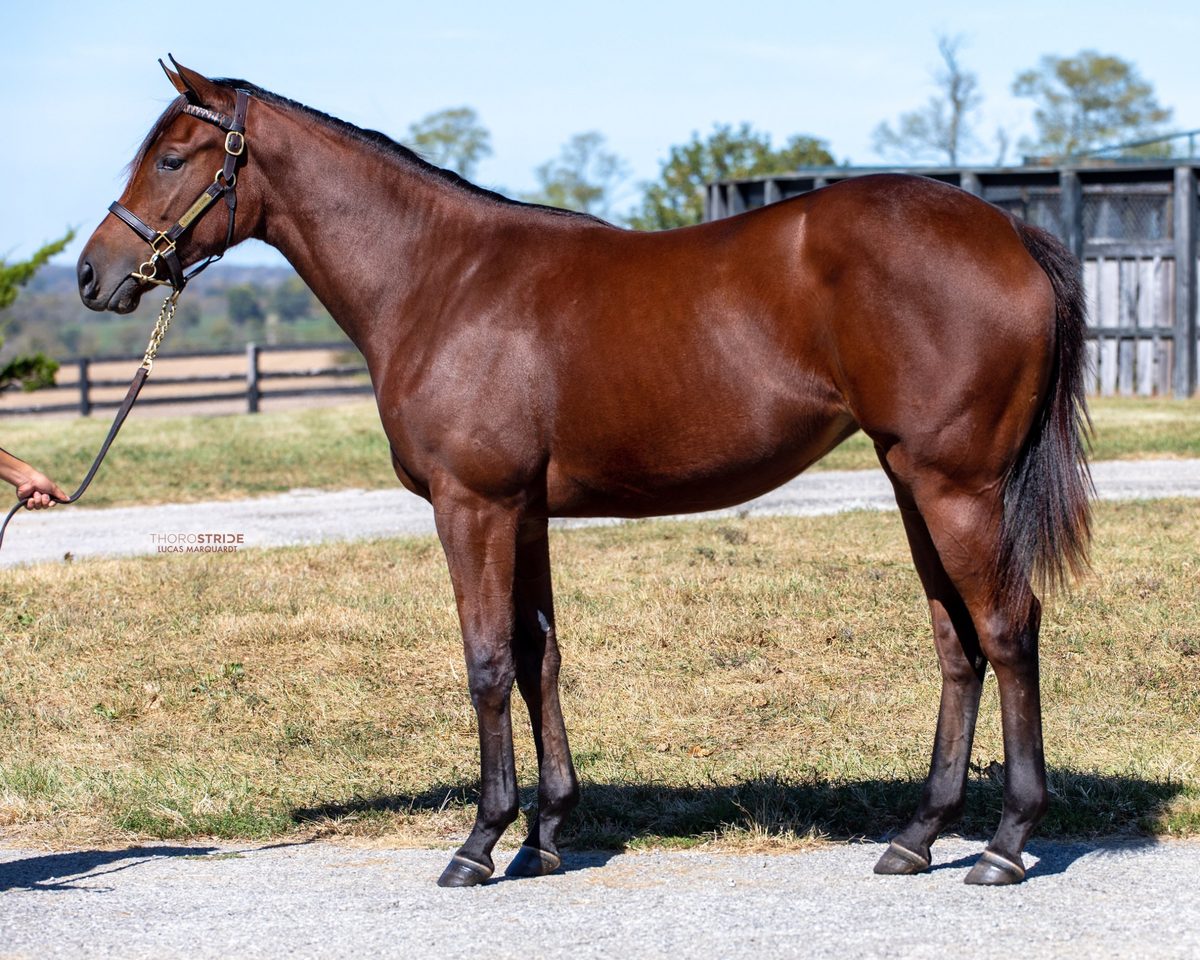
Bay filly, foaled February 22, 2025, by Uncle Mo out of Velvet Crush, by Tapit. Consigned by Heartwood Farm, Agent.
Prepared by Thoroughbred Intelligence
October 20, 2026 · Reference TI-FTOCT26-H426
The sale video for this filly is available in the web version of this memo.
Lot Identification
- Hip
- 426
- Sale
- Fasig-Tipton Kentucky October Yearlings 2026, Session 2
- Barn
- 4
- Consignor
- Heartwood Farm, Agent
- Sex
- Filly
- Foaled
- February 22, 2025
- Sire
- Uncle Mo
- 1st Dam
- Velvet Crush
- Dam Sire
- Tapit
- 2nd Dam
- White Clover, by Exchange Rate
- Maternal Family
- White Clover, Ermine, Red Mischief, Modernistic
- Dam Status
- Stakes-placed winner
- Produce Status
- Two foals of racing age, both raced
- Eligibility
- Breeders’ Cup nominated; KTDF
- Result
- Sold for $800,000 to Donato Lanni, agent for Lundergan Stables
Racing Profile Overview
Hip 426 combines Uncle Mo’s established Grade 1 influence with a stakes-placed Tapit mare whose own performances demonstrate juvenile ability, dirt-route success and continued effectiveness through four. The immediate female family adds stakes winner White Clover and her full sister, Grade 1 winner and Kentucky Oaks runner-up Ermine.
The two closest dams provide measurable racing credentials. Velvet Crush achieved an Equibase Speed Figure of 98 and a best Thoro-Graph figure of 6 at two, three and four. White Clover reached an Equibase figure of 103 and improved her best Thoro-Graph figure from 8 at two to 4½ at three. These performances support a combination of early ability and continued racing value beyond the juvenile season.
Maternal half-sister Guns of Roses has increased her earnings to $27,930, adding current racing activity to a young produce record. The strongest established class evidence remains concentrated in the first dam’s own performance, the second dam’s stakes record and Ermine’s Grade 1 achievements.
The central racing interpretation is a dirt-oriented filly with credible juvenile opportunity and a developing mile-to-route profile. Six to eight furlongs represents a reasonable juvenile working range, with seven to nine furlongs the principal mature projection. A mile to 1 1/16 miles is the most defensible center of the distance assessment.
Sire Influence | Juvenile Ability and Racing Class
Uncle Mo has produced Grade 1 winners including Nyquist, Adare Manor, Arabian Knight, Kingsbarns and Mo Donegal. Golden Pal’s Breeders’ Cup Turf Sprint [G1] success also establishes high-class turf performance within the sire’s record.
His progeny record includes 215 two-year-old winners, providing a substantial basis for considering juvenile racing opportunity. The individual mating requires a more specific interpretation, guided by the dam’s performance and the results of related crosses.
Kingsbarns is particularly relevant because he is by Uncle Mo out of a Tapit mare. His Grade 1 success establishes a high-class outcome from the exact sire/broodmare-sire combination. Toupie, a Grade 3 winner from the same cross, supplies an additional graded-performance reference.
For Hip 426, the closest maternal performances give the strongest direction to the distance and surface assessment. Velvet Crush and White Clover both won on dirt beyond a mile, providing a foundation for evaluating the filly as a potential dirt miler with scope for further distance.
Sire assessment: Uncle Mo supplies established juvenile production and Grade 1 class. The immediate female family gives this mating a more specific orientation toward dirt racing around a mile and beyond.
First Dam | Racing Ability and Performance Measures
Velvet Crush, by Tapit, won three races from two through four and earned $196,731. Her stakes performances include thirds in the Perfect Sting Stakes and Joseph E. Spanky Broussard Memorial Stakes.
Her career comprised 15 starts, with all three victories on dirt. Those wins included an allowance optional claiming race over 8½ furlongs at Churchill Downs. She achieved a best Equibase Speed Figure of 98 and a Class Performance Index of 2.83.
- 3 / 15Velvet Crush, wins from starts
- 3 of 3Wins on dirt
- $196,731Earnings
The distance and surface evidence are important. They establish that the first dam could carry her speed through a route while retaining winning effectiveness across three age groups.
Her Thoro-Graph history adds a separate developmental measure. Velvet Crush recorded a best figure of 6 at two, 6 at three and 6 at four, with corresponding age-and-sex percentile rankings of 99, 97 and 93. Lower Thoro-Graph figures represent stronger performances, while the percentiles place those performances within their respective comparison groups.
The appropriate interpretation is early ability retained across successive seasons. Her annual best figures remained at the same numerical level through four; the juvenile performance was already a substantial expression of her racing ability.
First-dam assessment: Velvet Crush contributes demonstrated juvenile capability, dirt-route success and multi-season winning performance. Her own racing record is presently the most developed performance evidence immediately beneath the subject.
Direct Sibling Evidence | Early Performance and Development
Guns of Roses, by Gun Runner
Guns of Roses has earned $27,930. Her early three-year-old performances include an Equibase figure of 74 and a Thoro-Graph figure of 14.
The increased earnings add continued racing activity within the first generation. The significance is incremental: another developing runner contributes to the mare’s produce history, while the stronger class references remain in Velvet Crush and the preceding maternal generations.
Celebrate, by Medaglia d’Oro
Celebrate earned $11,500 in her first two juvenile starts, recording an Equibase figure of 73 and a Thoro-Graph figure of 14. Her two-year-old participation provides an additional reference for early racing readiness within the first dam’s offspring.
The two half-sisters are at an early stage of their racing development. Their figures establish initial performance levels, while further racing will clarify the extent of their improvement.
Direct-produce assessment: The sibling evidence contributes early information rather than a fully developed measure of the mare’s class transmission. The more substantial foundation for Hip 426 remains the dam’s own racing ability and the stakes performance established beneath White Clover and Red Mischief.
Female Family | Class and Proximity
White Clover | Stakes Performance and Winner Production
The second dam, White Clover, by Exchange Rate, won four races from two through four, earned $166,257, and captured the Our Mims Stakes and Wayward Lass Stakes. She also finished third in the Monmouth Oaks [G3]. Her production record includes four winners from five runners.
White Clover made 14 starts, with all four victories on dirt. Her performances include a stakes victory at Delaware Park just beyond a mile, a best Equibase figure of 103 and a Class Performance Index of 2.92.
Her Thoro-Graph progression provides a useful contrast with Velvet Crush. White Clover improved from 8 at two to 4½ at three, before recording a best figure of 6½ at four. Her three-year-old performance ranked at the 98th percentile within its age-and-sex comparison group. This establishes juvenile ability followed by a stronger numerical performance at three.
Other offspring broaden the production evidence. Beatiful Karla won four races from two through five and earned $130,708. Frippet, by Ghostzapper, won twice at three and earned $108,000, with victories on dirt and turf and an 8½-furlong allowance success at the Meadowlands.
Ermine | The Closest Grade 1 Reference
Ermine is a full sister to White Clover, placing her racing achievements close to the direct female line.
She won five races at three and four, earned $880,134, and captured the Apple Blossom Handicap [G1], Falls City Handicap [G2] and Honeybee Stakes. Her Grade 1 placings included seconds in the Kentucky Oaks, Santa Margarita Invitational Handicap and Santa Maria Handicap.
Ermine supplies the strongest nearby example of elite female racing class. Her full relationship to White Clover makes that evidence relevant to the second dam’s pedigree, while her achievements remain collateral family evidence rather than a direct sibling result.
Red Mischief | Repeat Performance Across Several Branches
The third dam, Red Mischief, won ten races and earned $187,804. She produced six winners, including White Clover and Ermine.
Her daughter Legendary Peace produced Modernistic, twice a champion in Puerto Rico; Siding Spring, a Grade 3-placed performer; and Fayette Warrior, a stakes-placed runner with an extended winning career. These descendants distribute successful racing performance across another branch of the family.
Family-class assessment: The pedigree contains stakes placement in the first dam, stakes-winning and graded-placed performance in the second dam, and Grade 1-winning ability in the second dam’s full sister. The broader family adds repeated winning and substantial racing careers, strengthening the evidence beyond a single high-class individual.
Racing Development | Early Ability and Continued Maturation
The closest maternal evidence supports two-year-old racing opportunity.
Velvet Crush won at two and achieved the same best Thoro-Graph figure at that age that she subsequently recorded at three and four. White Clover also won at two, then improved her best figure at three. Both mares continued winning through four.
These records establish two useful developmental patterns: early ability that can be maintained, and juvenile ability followed by improvement with maturity.
The exact Uncle Mo/Tapit cross has produced three juvenile winners among 49 foals. That historical result supports a measured interpretation of precocity at the mating level, with the first two dams providing the more immediate evidence of early readiness.
The February 22 foaling date provides calendar context. The filly’s physical maturity, coordination and response to training should govern the timing of her racing introduction.
Developmental assessment: Credible juvenile opportunity with scope for continued effectiveness at three and four. The family supports a program that can make use of early ability while allowing distance capacity and racing experience to develop.
Distance Aptitude | A Mile-Oriented Dirt Profile
Juvenile working range: six to eight furlongs.
Mature working range: seven to nine furlongs, centered on a mile to 1 1/16 miles.
The strongest distance evidence comes from the closest mares. Velvet Crush won over 8½ furlongs, White Clover won a stakes race just beyond a mile, and Frippet supplies another 8½-furlong winner under the second dam.
These performances provide a practical basis for evaluating the filly as a route-capable runner. The distance interpretation follows actual family results rather than relying exclusively on the reputations of Uncle Mo and Tapit.
Six or seven furlongs could serve as introductory distances if she demonstrates the necessary speed and readiness. A subsequent progression toward a mile and 1 1/16 miles would test the aptitude most directly represented by the maternal performances.
Nine furlongs is a credible potential extension, requiring confirmation through her ability to settle, move efficiently and maintain her finishing effort.
Distance assessment: A mile-oriented working hypothesis with scope for a route program. The most strongly supported mature center is a mile to 1 1/16 miles, with the broader seven-to-nine-furlong range dependent on individual development.
Surface Aptitude | Dirt Leads the Evidence
Dirt is the primary pedigree-supported surface.
Velvet Crush’s three victories and White Clover’s four victories were achieved on dirt. Their success beyond a mile gives the surface assessment an immediate performance foundation.
Turf has supporting references within the pedigree. Frippet won on both dirt and turf, while Uncle Mo’s progeny include Breeders’ Cup Turf Sprint [G1] winner Golden Pal. These performances justify retaining turf as an alternative if the filly’s action and racing response point in that direction.
The weight of the closest maternal evidence remains with dirt. Surface flexibility elsewhere in the pedigree broadens the available options without displacing that central interpretation.
Surface assessment: Dirt first, with turf a supported secondary possibility. Individual movement, balance, acceleration and race performance should determine whether the alternative becomes a substantive part of the racing program.
Maternal Toughness | Longevity and Repeat Performance
The female family provides several levels of durability evidence.
Velvet Crush made 15 starts and won from two through four. White Clover made 14 starts and also won from two through four. Those records establish juvenile participation followed by continued winning effectiveness across successive seasons.
Beatiful Karla supplies a more extensive participation record under the second dam, with 37 starts and four victories through five. Her career adds evidence of sustained racing activity within the immediate maternal generation.
The Red Mischief branch extends that pattern. Modernistic won 12 races from two through five. Siding Spring won six races from two through seven. Fayette Warrior accumulated 25 victories from two through nine.
These records answer a different question from Ermine’s Grade 1 performances. Ermine establishes the family’s demonstrated upper level of racing class. The extended careers of the repeat winners establish longevity and the ability to remain effective over time.
Durability assessment: Favorable family-level evidence of repeated winning, multi-season participation and retained racing effectiveness. These histories support a longer-term developmental perspective, while individual soundness, recovery characteristics and training tolerance require direct assessment.
Mating Analysis | Exact-Cross Results and Statistical Context
The mating carries a TrueNicks rating of C. This is a comparative assessment of sire-line and broodmare-sire-line affinity, separate from the performance ratings of the individual mares and the quality demonstrated elsewhere in the female family.
The exact Uncle Mo × Tapit cross comprises 49 foals, 38 starters, 25 winners, three stakes winners and two graded stakes winners. Its graded performers are Kingsbarns [G1] and Toupie [G3].
- 49Foals on the exact cross
- 38Starters
- 25Winners
- 2Graded stakes winners
Those results represent approximately 65.8% winners from starters and 7.9% stakes winners from starters. They establish successful outcomes, including Grade 1 ability, while describing a population rather than the individual yearling’s probability of success.
The broader sons-of-Indian-Charlie/Tapit pattern contains 46 starters, 33 winners and five stakes winners. Its graded winners include the same Kingsbarns and Toupie, so the broader results provide context around overlapping racing evidence.
The C rating supports a measured interpretation of statistical affinity. The presence of graded winners establishes the cross’s capacity to produce high-class performers, while the mare’s own racing record and female-family depth remain central to the individual evaluation.
Mating assessment: Demonstrated graded-class outcomes on the exact cross, with the strongest case for Hip 426 resting on the combination of maternal performance, family class and individual athletic suitability.
Pedigree Structure | Racing Implications
The mating combines Uncle Mo’s Indian Charlie line with Tapit through Pulpit. White Clover introduces Exchange Rate beneath the first dam, with Red Mischief providing the next maternal generation.
The dosage profile is 3-15-24-0-0, with a Dosage Index of 2.50 and Center of Distribution of +0.50. These are pedigree classifications and remain distinct from the Equibase and Thoro-Graph measures of actual racing performance.
The practical racing interpretation rests more firmly on the closest mares’ results. Juvenile success appears in both Velvet Crush and White Clover, while their dirt victories beyond a mile support the capacity to carry speed into route competition.
Pedigree assessment: Early racing ability and dirt-route performance are represented in successive maternal generations. The principal question is how effectively the filly combines those characteristics in her own development.
Racing Application and Final Assessment
The pedigree supports an American racing program that first evaluates dirt speed, then determines how that speed is sustained as races lengthen. An introductory sprint could establish gate behavior, tactical positioning and response under race conditions. Progression toward a mile and 1 1/16 miles would address the distance aptitude most directly supported by the family.
The central developmental question is whether the filly can express early ability comparable in pattern to Velvet Crush while retaining scope to maintain or improve her performance through maturity.
The strongest evidence is concentrated in three areas. Velvet Crush contributes measurable juvenile ability and successful dirt racing through four. White Clover adds stakes-winning performance, a stronger three-year-old figure and four winning offspring. Ermine supplies the closest Grade 1 female-class precedent through her full relationship to White Clover.
Guns of Roses’ increased earnings add activity to the immediate produce record. The sibling evidence remains developmental, with the more established performance foundation residing in the first two dams and the nearby Grade 1 branch.
Projection Summary
- Racing projection
- A dirt-oriented filly with a mile-to-1 1/16-mile developmental focus and a seven-to-nine-furlong mature working range.
- Developmental outlook
- Credible juvenile opportunity, supported by early ability in the first two dams and evidence of continued effectiveness through four.
- Surface profile
- Dirt preferred. Turf remains a secondary option supported by the sire and the second dam’s production.
- Durability assessment
- Favorable family-level evidence of repeat winning, multi-season participation and sustained racing effectiveness.
- Class interpretation
- Stakes and graded-class performance are established close to the subject, with Grade 1 ability through Ermine and the exact sire/broodmare-sire cross. The filly’s attainable level remains an individual athletic question.
The central proposition is a filly with the pedigree foundation to show ability at two and develop into an effective dirt runner around a mile and beyond. Her own maturity, locomotion, balance, temperament and veterinary findings should determine how strongly that interpretation translates into a racing plan.
Basis and Limitations
This memo is analytical opinion based on pedigree, family-performance and mating evidence available at the date of analysis. It is a pedigree-based racing projection and does not incorporate physical inspection, cardiovascular evaluation, radiographic or endoscopic review. It is not a guarantee of racing outcome.
This is a sample of the racing analysis Thoroughbred Intelligence produces for clients, written on a yearling that sold publicly and published in full. Client memos are delivered privately and are not published. Request an introduction to discuss a catalog.