
Five Colts, $9.65 Million, and an Early Report Card
What we learned from our Book 1 colt rankings.
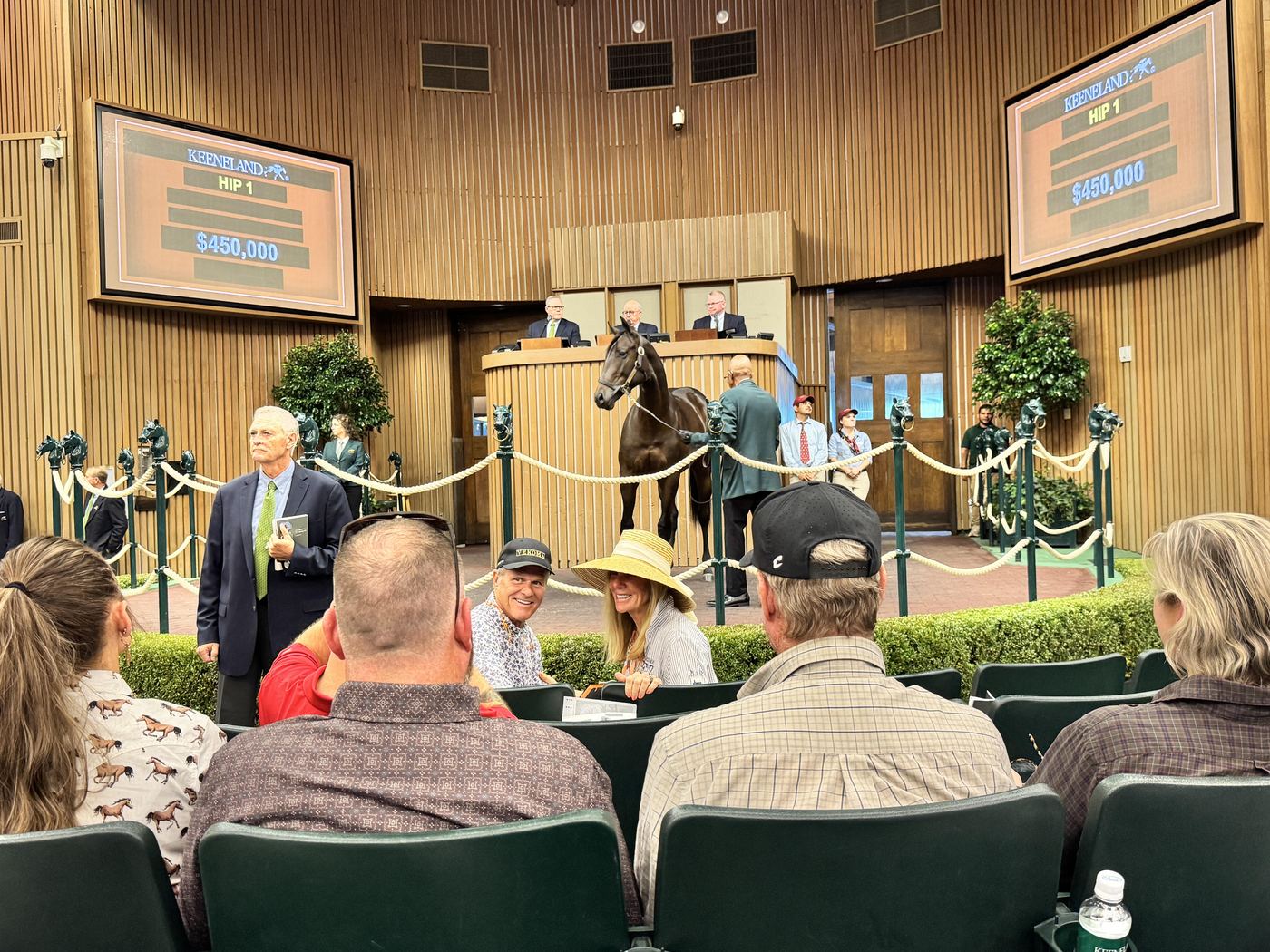
We make a habit of grading ourselves at Thoroughbred Intelligence.
Part of that is practical. Every prediction gives us another opportunity to learn, refine the platform and understand where our analysis is working and where it needs improvement.
After all, we make a habit of rigorously scrutinizing these beautiful animals on paper. We dissect their pedigrees, production records, development patterns and racing families. We assign scores, rank them and point out strengths and weaknesses.
It seems only fair that we put our own work under the same microscope.
Four days before Book 1 of the Keeneland September Yearling Sale began, we published our five highest-rated colt pedigrees for racing.
The exercise was intentionally narrow. We ignored price and asked a simple question:
If every Book 1 colt cost the same amount and passed the same physical and veterinary examination, which pedigrees would we most want to own for racing?
We ranked Hip 158, Curlin out of Cavorting, first with a 96.0 racing score. Hip 17, Gun Runner out of Seeking Gabrielle, was second at 94.4. Hip 47, Gun Runner out of Stage Magic, was third at 92.6. Hip 242, Into Mischief out of Grazie Mille, was fourth at 92.2. Hip 181, Not This Time out of Danzatrice, rounded out the five at 91.7.
Starting With an Already Elite Group
Book 1 is an important part of this story because Keeneland has already done a lot of filtering before we ever open the catalog.
The book contained hundreds of yearlings by many of the best stallions in the world, out of accomplished racemares and producers, from families filled with Grade 1 horses. Many were bred and consigned by the most successful operations in the business.
Finding five good pedigrees in Book 1 would hardly be an accomplishment. The book is full of them.
The challenge was separating one elite page from another and identifying the pedigrees where several different pieces of racing evidence reinforced the same conclusion.
There was also a major piece of information missing from our public exercise. We had never seen the horses.
Our rankings came from the catalog and data. We had pedigree, production, racing evidence, developmental patterns and mating information. The buyers at Keeneland had all of that plus the opportunity to inspect the individuals and conduct their own veterinary, repository and other due diligence.
That distinction matters in an acquisition decision. When we work directly with clients, our analysis is designed to sit alongside the horse-specific information supplied by their team. For this public exercise, we intentionally stopped at the page.
Five Horses, $9.65 Million
The five colts brought a combined $9.65 million.
Four sold for seven figures. The fifth sold for $550,000.
The buyer list was every bit as impressive.
Coolmore's M.V. Magnier bought two, one in partnership with Peter Brant's White Birch Farm. Winchell Thoroughbreds bought another. J.S. Company purchased one for Japanese owner Yosuke Imafuku. Flying Dutchmen bought our top-ranked colt.
For those less familiar with the upper end of the Thoroughbred market, these are serious players. Coolmore is one of the world's dominant racing and breeding operations. Peter Brant has competed at the highest levels of American and international racing for decades. Winchell campaigned Gun Runner and continues to operate at the top of American racing. Japanese buyers have become an important presence at elite American bloodstock sales, while Flying Dutchmen has assembled an increasingly ambitious racing operation under Travis Boersma.
We did not predict these prices. That was never the exercise. We identified five pedigrees we thought stood above an already exceptional Book 1 group for racing. The buyers had the benefit of evaluating the actual horses, and all five attracted substantial bids.
The racing will eventually tell us far more. For now, it is worth revisiting what put each horse on our list.
No. 1: Hip 158
Curlin out of Cavorting, by Bernardini
- Racing score: 96.0
- Sale price: $550,000
- Buyer: Flying Dutchmen
Hip 158 began with about as strong a piece of pedigree evidence as we can ask for. The exact Curlin-Cavorting mating had already produced Clairiere, winner of more than $3.2 million and four Grade 1 races.
There was evidence beyond Clairiere. Another full sibling, Judge Miller, became graded-placed, while Courting won at two. Cavorting herself won eight of 13 starts and more than $2 million, including three Grade 1 races.
Our deeper work also showed a family with plenty of staying power. Judge Miller has remained competitive through age five. Cavorting's half-sister Promenade Girl produced Grade 2 winner Moon Colony and Thirstforlife, a seven-time winner of more than $525,000 who repeatedly competed in graded company.
Clairiere was the obvious headline, but our interest went well beyond being her full brother. The branch kept producing horses with class and durability, and the exact mating had worked more than once.
Flying Dutchmen bought Hip 158 for $550,000, easily the lowest price among our five.
We still love the page.
Flying Dutchmen is a serious operation, and their team had the advantage of evaluating the colt himself. They saw enough to invest more than half a million dollars. Whether they found something the broader market undervalued is a question his racing career will answer.
Of the five, he may be the one I am most curious to follow.
No. 2: Hip 17
Gun Runner out of Seeking Gabrielle, by Forestry
- Racing score: 94.4
- Sale price: $1.4 million
- Buyer: M.V. Magnier / White Birch Farm
Nyquist was the obvious place to start with Hip 17.
Seeking Gabrielle produced a champion two-year-old who won the Breeders' Cup Juvenile, Del Mar Futurity and FrontRunner, then returned at three to win the Florida Derby and Kentucky Derby.
That two-to-three-year-old progression was almost exactly what we were trying to identify.
What gave us additional confidence was everything around Nyquist.
Second dam Seeking Regina won the Adirondack at two. The family also produced Metropolitan Handicap winner Sahara Sky. Seeking Gabrielle's daughter Gabriellestoblame has already extended the branch by producing Grade 3 winner Sabatini.
The supplied Gun Runner/Storm Cat-line data added another positive signal, with 40 winners and six stakes winners from 55 starters. The direct Gun Runner/Forestry sample was tiny, so we gave the larger body of evidence more weight.
Nyquist gave us the ceiling. The rest of the family gave us reason to believe the quality could keep transmitting.
M.V. Magnier and White Birch Farm paid $1.4 million for the colt.
No. 3: Hip 47
Gun Runner out of Stage Magic, by Ghostzapper
- Racing score: 92.6
- Sale price: $1.9 million
- Buyer: Winchell Thoroughbreds
We called Hip 47 a mare-driven case in the original article. Looking back, that may have understated it.
Stage Magic produced Justify by Scat Daddy, The Lieutenant by Street Sense and Stage Raider by Pioneerof the Nile.
Three accomplished sons by three different sires. Four of her seven runners became winners, and three of those four reached stakes level.
Stage Magic was 18 when this colt was foaled. Her age was worth considering, but her actual production carried more weight for us. She had already demonstrated that she could produce high-class runners across multiple sire lines, including an undefeated Triple Crown winner.
Winchell Thoroughbreds paid $1.9 million for her Gun Runner colt.
The buyer makes this one especially interesting. Winchell raced Gun Runner in partnership with Three Chimneys and knows the sire as well as anyone in the business. They had the opportunity to evaluate this colt in person and made a substantial investment in another son of Gun Runner.
No. 4: Hip 242
Into Mischief out of Grazie Mille, by Bernardini
- Racing score: 92.2
- Sale price: $3.7 million
- Buyer: Coolmore / M.V. Magnier
Hip 242 became the most expensive of our five when Coolmore's M.V. Magnier went to $3.7 million.
We had ranked him fourth because the page offered an unusually balanced collection of racing signals.
Grazie Mille produced Mo Town, winner of the Remsen at two and the Hollywood Derby at three. Justique won stakes at two and remained graded-placed across multiple seasons. Champagne Lady was stakes placed. The family kept supplying juvenile ability along with evidence that the class could carry forward.
There was also an interesting mating signal buried in the data.
The direct Into Mischief/Bernardini cross had produced 25 winners from 34 starters, including 16 winners from 19 colt starters. The average winning distance of the cross ran longer than Into Mischief's overall progeny average.
That fit Grazie Mille particularly well. She had already produced Mo Town, who showed Grade 2 route ability at two and developed into a Grade 1 winner at three. The mating offered another reason to believe the speed on top could stretch.
Magnier and the Coolmore team saw the individual and went to $3.7 million.
No. 5: Hip 181
Not This Time out of Danzatrice, by Dunkirk
- Racing score: 91.7
- Sale price: $2.1 million
- Buyer: J.S. Company for Yosuke Imafuku
Hip 181 kept giving us juvenile signals from different parts of the pedigree.
Danzatrice won at two. Her son Tapit Trice won at two before developing into a Grade 1-winning route horse. Under the second dam sat Jaywalk, champion two-year-old filly and winner of the Breeders' Cup Juvenile Fillies and Frizette.
Then came Not This Time, himself a Grade 3 winner and Breeders' Cup Juvenile runner-up at two.
The family had already shown that early ability could carry into serious route performance.
The wrinkle was Danzatrice's production history. Her three winners in our detailed record were all by Tapit. Hip 181 moved her to a completely different sire line.
Not This Time brought his own juvenile ability and a broader record of transmitting class, while Danzatrice had already proved she could produce a Grade 1 route horse.
J.S. Company bought the colt for Yosuke Imafuku at $2.1 million.
So, How Did We Do?
Pretty well so far.
All five of our highest-rated Book 1 colt pedigrees attracted serious buyers. Four brought seven figures. Together they sold for $9.65 million.
The five reached the top of our rankings for very different reasons.
Hip 158 had the strongest exact-mating evidence and a family that kept producing class and durability. Hip 17 combined Nyquist's exceptional juvenile-to-classic trajectory with continued quality through the family. Hip 47 showed what a great producing mare can do across different stallions. Hip 242 paired a productive female family with mating data that fit what the mare had already produced. Hip 181 had juvenile ability coming from several directions along with proven Grade 1 route class.
There was no magic pedigree formula. In each case, several pieces of evidence reinforced one another.
That is where the Thoroughbred Intelligence platform helps. Recognizing Clairiere, Nyquist, Justify, Mo Town or Tapit Trice on a catalog page is easy. Comparing hundreds of already excellent pedigrees consistently is much harder. Our platform lets us apply the same standards across the entire book, weighing production, proximity, development, durability and mating evidence horse by horse.
For this exercise, we stopped at the page. The buyers got to evaluate the horses themselves, and all five ultimately attracted substantial bids from experienced operations.
The sale results are worth noting. The racing results will matter much more.
We will keep following all five and grading ourselves as their careers unfold. Some of what we believed will hold up. Some of it will probably teach us something new.
We scrutinize the horses. It is only fair that we hold our own work to the same standard.
The original Book 1 rankings were published September 11, 2026, before the horses entered the sales ring. The racing scores and rankings above are unchanged from that publication. The public exercise was based on pedigree and racing data and did not incorporate physical, veterinary or repository information. Those inputs can be incorporated when supplied in direct client acquisition work. Ultimately, the racetrack will tell us far more about these five selections than their auction prices ever could.