
Keeneland September Book 1: Our Five Highest-Rated Colt Pedigrees for Racing
Every catalog has a few pages that make you look twice. These are the five Book 1 colt pedigrees that set our hair on fire.
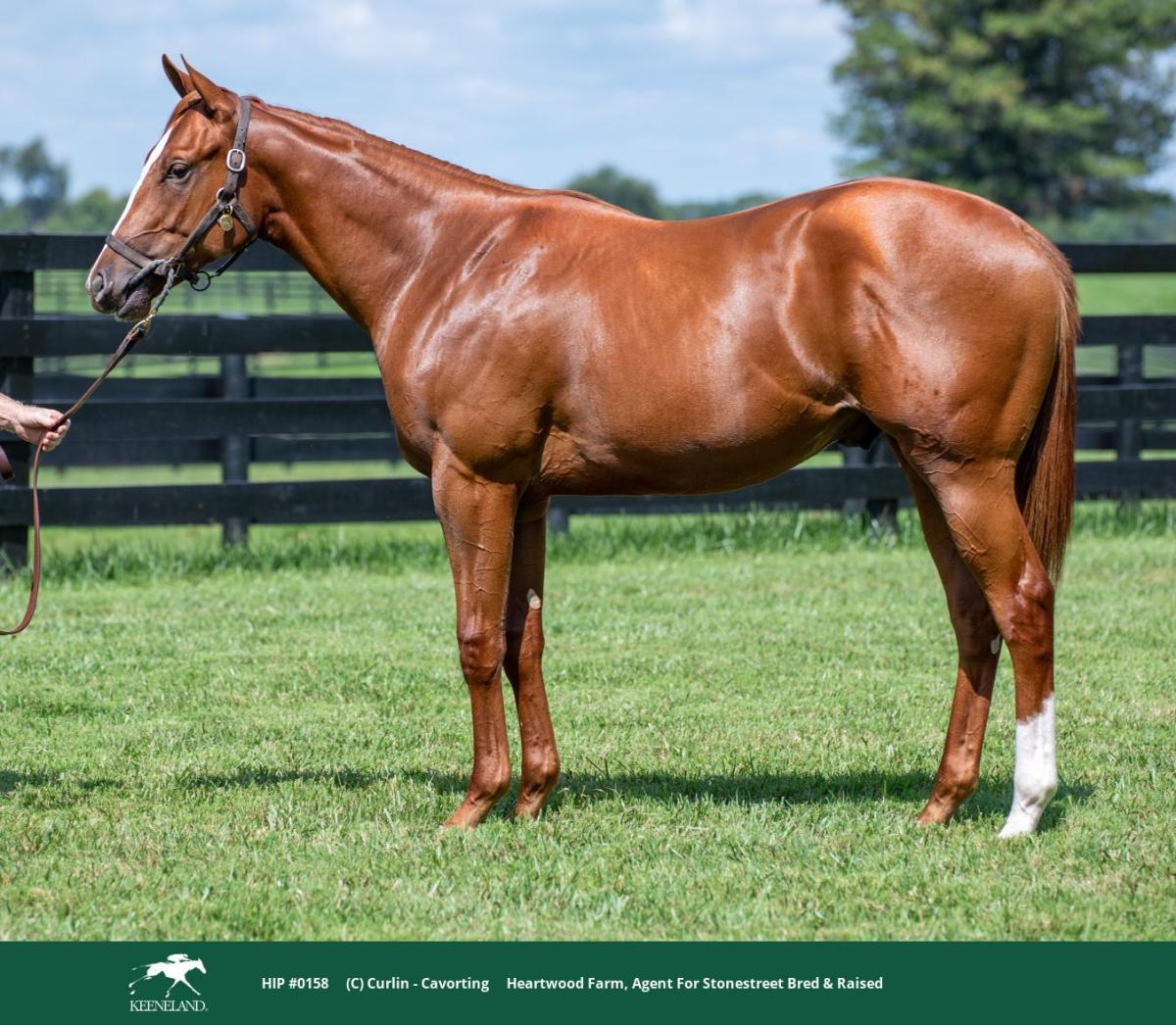
For this exercise, we ranked the Book 1 colts strictly on pedigree-based racing potential.
The framework emphasizes elite class close to the subject, female-family production, sire performance, meaningful two-year-old evidence, development through the three-year-old season, durability and mating coherence.
The question is simple:
If every Book 1 colt cost the same amount and passed the same physical and veterinary examination, which pedigrees would we most want to own for racing?
These were our five highest-rated colts.
| Rank | Hip | Sire | Dam | Dam's sire | Racing score |
|---|---|---|---|---|---|
| 1 | 158 | Curlin | Cavorting | Bernardini | 96.0 |
| 2 | 17 | Gun Runner | Seeking Gabrielle | Forestry | 94.4 |
| 3 | 47 | Gun Runner | Stage Magic | Ghostzapper | 92.6 |
| 4 | 242 | Into Mischief | Grazie Mille | Bernardini | 92.2 |
| 5 | 181 | Not This Time | Danzatrice | Dunkirk | 91.7 |
1. Hip 158, Curlin out of Cavorting, by Bernardini
- Racing score: 96.0
- Dirt
- 2YO: 7 to 8½f
- 3YO: 8 to 10f
- Moderate precocity
- Exceptional train-on
- High confidence
Hip 158 starts with the strongest form of pedigree evidence available: the exact mating has already produced an elite racehorse.
Curlin and Cavorting produced Clairiere, winner of more than $3.2 million and four Grade 1 races, including the Cotillion, Apple Blossom and Ogden Phipps twice. Another full sibling, Judge Miller, is graded placed, while Courting, also by Curlin, won at two.
Cavorting brings plenty of her own class. She won eight of 13 starts and more than $2 million, with victories in the Test [G1], Ogden Phipps [G1], Personal Ensign [G1], Adirondack [G2], Prioress [G2] and Ruffian [G2]. Her Medaglia d'Oro daughter La Crete also became a stakes winner.
The broader Curlin/Bernardini cross reinforces the immediate family. The supplied data show 72 foals of racing age, 52 starters, 28 winners and 11 stakes winners. Among colts, 30 starters produced 19 winners and six stakes winners.
That broader sample gives extra weight to what Cavorting has already demonstrated herself. Clairiere sits within a productive cross rather than standing alone as a single exceptional result.
The likely racing profile is dirt and two turns. Cavorting contributes meaningful juvenile ability, while Curlin and Bernardini add a strong developmental base for three. We would expect enough speed to make racing at two realistic, with the greater upside arriving as distances stretch toward a mile and beyond.
The remaining question is scale. Cavorting has four runners, with Clairiere setting a very high standard. Judge Miller and Courting are important because they show the Curlin mating has reproduced quality more than once.
Hip 158 ranks first because the evidence aligns at every level: elite dam, elite full sibling, repeated success from the exact mating and a productive broader cross.
2. Hip 17, Gun Runner out of Seeking Gabrielle, by Forestry
- Racing score: 94.4
- Dirt
- 2YO: 6½ to 8f
- 3YO: 8 to 9½f
- Above-average precocity
- Exceptional train-on
- High confidence
Hip 17 is built around one of the clearest two-to-three-year-old developmental patterns in the book.
Seeking Gabrielle produced Nyquist, champion two-year-old colt and winner of the Breeders' Cup Juvenile [G1], Del Mar Futurity [G1] and FrontRunner [G1]. He returned at three to win the Florida Derby [G1] and Kentucky Derby [G1].
For a racing screen centered on the first two seasons, that progression carries enormous weight. Nyquist had genuine Grade 1 class at two and carried it directly into classic-level form at three.
The family behind Seeking Gabrielle adds depth. Second dam Seeking Regina won the Adirondack [G2] at two and produced several black-type performers. Her daughter Seeking the Sky became the dam of Metropolitan Handicap [G1] winner Sahara Sky. Third dam Fulbright Scholar was a stakes winner and connects into another productive graded branch.
Gun Runner adds another major source of dirt class and three-year-old progression. The broader Gun Runner/Storm Cat-line population in the supplied data contains 55 starters, 40 winners and six stakes winners. Colts account for 24 winners and four stakes winners from 32 starters.
The direct Gun Runner/Forestry sample remains very small, so the female family carries more weight than the mating statistics in this case.
Seeking Gabrielle has four winners from five runners in the detailed record, with Nyquist accounting for the elite direct result. Her daughter Gabriellestoblame has extended the branch by producing Grade 3 winner Sabatini.
The projected profile is straightforward: dirt, enough speed to matter at two, and enough sire-side scope to progress around two turns at three.
Hip 17 ranks this highly because Nyquist represents almost exactly the racing trajectory we are trying to identify in a yearling pedigree: high class at two, then classic class at three.
3. Hip 47, Gun Runner out of Stage Magic, by Ghostzapper
- Racing score: 92.6
- Dirt
- 2YO: 7 to 8f
- 3YO: 8½ to 10f+
- Moderate to above-average precocity
- Exceptional train-on
- High confidence
Hip 47 is a mare-driven case.
Stage Magic produced Justify by Scat Daddy, The Lieutenant by Street Sense and Stage Raider by Pioneerof the Nile.
Three accomplished sons, three different sires.
That gives us strong evidence that Stage Magic herself is transmitting the class.
Justify supplies the ceiling. He was Horse of the Year, champion three-year-old and the undefeated winner of the Kentucky Derby [G1], Preakness [G1] and Belmont [G1]. The Lieutenant won the All American [G3] and placed in the Suburban [G2] and Californian [G2]. Stage Raider won stakes and finished second in the Ack Ack [G3].
Four of Stage Magic's seven runners became winners, and three of those four reached stakes level.
The next two generations add substance. Second dam Magical Illusion, by Pulpit, was Grade 1-placed. Third dam Voodoo Lily was a Grade 3 winner and sits behind a broad group of graded performers and successful producing branches.
Gun Runner fits the family well from a racing standpoint. He brings elite dirt ability, tactical speed and sustained route class. The supplied material offers limited direct Gun Runner/Ghostzapper broodmare-sire data, so the case rests primarily on Gun Runner's proven sire performance and Stage Magic's production record across multiple stallions.
The distance projection comes from the race record. Stage Magic produced a Kentucky Derby winner and a Belmont winner. The Lieutenant carried his form around two turns. Gun Runner repeatedly sires high-class route horses.
That points toward a colt whose strongest upside lies from a mile through classic distances.
The juvenile case is less defined than the three-year-old case. Gun Runner supplies enough early capability for meaningful racing at two, while Stage Magic's best runner reached his peak after beginning at three.
Stage Magic was 18 when this colt was foaled, and seven of her 11 foals had raced in the supplied record. The quality of those runners remains the dominant feature of the page.
Hip 47 ranks third because Stage Magic has already demonstrated the ability to transmit serious racing ability through several different sire lines.
4. Hip 242, Into Mischief out of Grazie Mille, by Bernardini
- Racing score: 92.2
- Dirt with turf versatility
- 2YO: 7 to 8½f
- 3YO: 8 to 10f
- Above-average precocity
- Strong train-on
- High confidence
Hip 242 has one of the most balanced profiles in the group.
Grazie Mille has produced four winners from five runners. Her best runner, Mo Town, won the Remsen [G2] at two and later the Hollywood Derby [G1] at three. Justique won stakes at two and remained graded-placed across multiple seasons. Champagne Lady was stakes placed.
The juvenile signal also carries into the next generation. Grazie Mille's daughter Vita Bella produced West Memorial, winner of the Kentucky Juvenile.
That gives the family several independent sources of early racing ability, along with proof that the class can carry forward.
Second dam Molto Vita was a Grade 3 winner and multiple Grade 1-placed sprinter. Third dam Princess Polonia also won at Grade 3 level. The female family repeatedly combines speed with enough substance to stretch that speed into longer races.
The direct Into Mischief/Bernardini cross adds another meaningful layer. The supplied data show 39 foals of racing age, 34 starters, 25 winners and four stakes winners. Colts have produced 16 winners from 19 starters.
The average winning distance of the cross also runs longer than Into Mischief's overall progeny average. That matters here. Bernardini contributes route capacity, and Grazie Mille has already produced a juvenile route winner who developed into a Grade 1 three-year-old.
Dirt is the primary projection. Mo Town's Hollywood Derby adds real turf versatility to the immediate family.
Grazie Mille has nine foals and five runners in the detailed record, with several younger horses affecting the completeness of that sample. The quality among her runners is already established.
Hip 242 earns his place through balance: juvenile evidence, route development, productive first-dam performance and one of the strongest direct broodmare-sire cross datasets among these five.
5. Hip 181, Not This Time out of Danzatrice, by Dunkirk
- Racing score: 91.7
- Dirt with secondary versatility
- 2YO: 7 to 8½f
- 3YO: 8 to 9½f
- Above-average precocity
- Exceptional train-on
- High confidence
Hip 181 combines elite juvenile evidence in the family with proven Grade 1 route production from the first dam.
Danzatrice was a multiple stakes winner who raced successfully from two through five. Her best runner is Tapit Trice, winner of the Blue Grass [G1], Tampa Bay Derby [G3], Monmouth Cup [G3] and later Woodward [G2]. At three, he also placed in the Belmont [G1] and Travers [G1].
The second dam brings the juvenile component. Lady Pewitt produced Jaywalk, champion two-year-old filly and winner of the Breeders' Cup Juvenile Fillies [G1] and Frizette [G1].
Danzatrice won at two. Tapit Trice won at two. Jaywalk reached championship level at two.
Those are three separate sources of juvenile ability inside the immediate family.
Not This Time reinforces that profile. He won the Iroquois [G3] and finished second in the Breeders' Cup Juvenile [G1] at two, and his progeny record now shows high-level performance across dirt and turf. The supplied statistics give him a 2.22 AEI and 78 lifetime black-type winners.
The mating data are encouraging. The broader Not This Time/Unbridled's Song-line population produced 19 winners and three stakes winners from 28 starters. Colts produced 12 winners and two stakes winners from 16 starters.
The key question is Danzatrice's sire-specific production.
Her three current winners are all by Tapit, with Tapit Trice accounting for the black type. Hip 181 introduces a different sire line, which gives the mating an extra layer of uncertainty and upside.
Not This Time adds more demonstrated juvenile speed and broader surface versatility. Danzatrice supplies proven dirt-route ability.
Hip 181 makes the five because the family brings together champion juvenile evidence, direct Grade 1 production and a sire capable of contributing class at both two and three.
Five different reasons to believe
These five pedigrees reached the top through different kinds of evidence.
Hip 158 has the strongest exact-mating proof.
Hip 17 has the clearest example of juvenile class carrying directly into classic three-year-old form.
Hip 47 stands out through Stage Magic's ability to produce high-class runners by several different sires.
Hip 242 combines a productive first dam with strong direct Into Mischief/Bernardini evidence.
Hip 181 brings together champion juvenile form and proven Grade 1 route production, with an additional mating question created by the shift away from Tapit.
The common thread is proximity and repeatability. High-level racing evidence close to the subject carries the most weight, especially when several independent pieces of the pedigree point toward the same outcome.