
Keeneland September Book 1: Our Five Highest-Rated Turf Pedigrees for Racing
Book 1 reflects an American market built around dirt. Here are five exceptional turf pedigrees hiding inside.
Like a lot of Americans, I came into racing through the big dirt classics: speed, electricity, violence. The longer I have been around the sport, the more I have come to appreciate European turf, where the courses follow the land and the racing is tactical by design.
That taste is inconvenient in Kentucky in September. Book 1 reflects an American market built around dirt, speed, precocity and the prospect of a Classic horse.
But there are some exceptional turf pedigrees hiding in there anyway.
This is a racing-pedigree exercise. Price, physical and veterinary evaluation belong in separate columns. Here, every horse starts on equal footing. The question is straightforward:
Which five Book 1 yearlings would we most want if the goal were to produce a high-class turf racehorse?
Like our other Book 1 top-five lists, quality comes in different forms, and the five turf pages we landed on get there in very different ways.
| Rank | Hip | Pedigree | Turf Racing Score | Surface | 2YO Range | 3YO+ Range | Confidence |
|---|---|---|---|---|---|---|---|
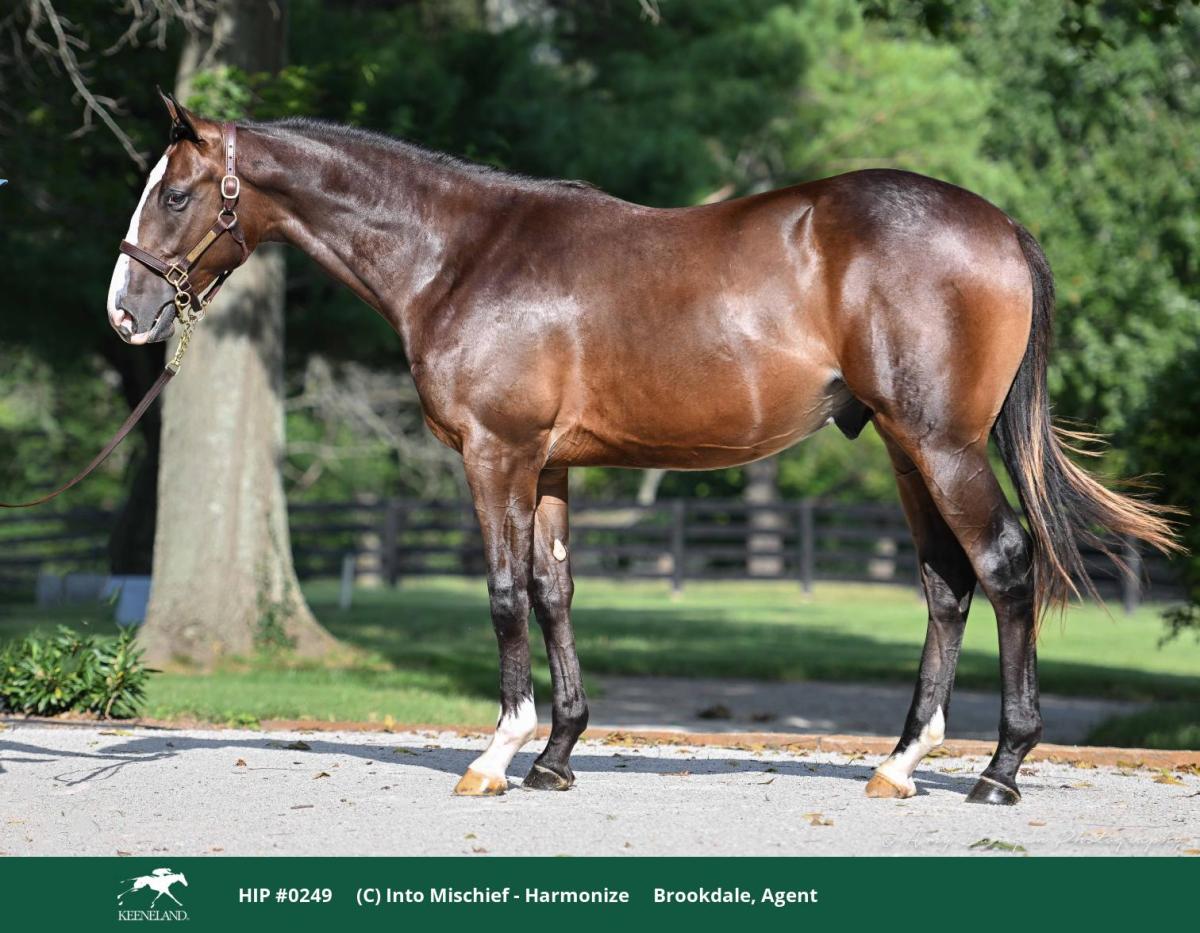
| 1 | 249 | Into Mischief x Harmonize | 92.0 | Turf primary | 7–8½f | 8–10f | High |
| 2 | 12 | Justify x Samaready | 91.5 | Turf primary | 5½–7f | 7–9f | High |
| 3 | 227 | Justify x Forever Together | 91.0 | Turf dominant | 7–9f | 9–12f | Med-High |
| 4 | 346 | Medaglia d'Oro x Odeliz | 87.0 | Turf primary | 7½–9f | 8½–11f | Med-High |
| 5 | 246 | Into Mischief x Happen | 85.0 | Turf lean | 6½–8f | 7–9½f | Med-High |
1. Hip 249
Into Mischief out of Harmonize, by Scat Daddy
- Turf Racing Score: 92.0
- Turf primary
- 2YO: 7–8½f
- 3YO+: 8–10f
- Moderate precocity
- Strong train-on
- High confidence
Hip 249 tops the list because the turf case sits directly under the first dam and requires very little projection.
Harmonize won the Del Mar Oaks [G1], Glens Falls [G3], Jessamine [G3] and P. G. Johnson, and finished second in the Queen Elizabeth II Challenge Cup [G1].
She has already transmitted that ability.
Her son Integration, by Quality Road, has won the Red Smith [G2], Hill Prince [G2], Virginia Derby [G3] and Million Preview. He has also placed in the Manhattan [G1], Arlington Million [G1], Pegasus World Cup Turf [G1] and Maker's Mark Mile [G1], with earnings above $1.85 million through 2026.
Harmonize has three winners from four runners. Integration gives us the key piece of evidence on the page: a Grade 1 turf mare who has already produced another high-class turf route horse.
Into Mischief brings speed, juvenile ability and broad surface versatility. The maternal evidence gives this colt his direction.
We see the center of the profile around a mile to ten furlongs on turf. Harmonize had graded ability at two, while Integration developed into a serious route horse from three onward. That gives the pedigree enough juvenile evidence to get started while leaving plenty of room for progression.
The production sample is still developing, with Integration carrying the black type among Harmonize's current runners. The quality and proximity of the evidence still separate Hip 249 from the rest of this group.
2. Hip 12
Justify out of Samaready, by More Than Ready
- Turf Racing Score: 91.5
- Turf primary
- 2YO: 5½–7f
- 3YO+: 7–9f
- Above-average precocity
- Strong train-on
- High confidence
Hip 12 is built around speed and juvenile class.
Samaready was Australian champion female sprinter. She won the Blue Diamond [G1] at two and the A. J. Moir [G1] later in her career, along with additional Group 2 and Group 3 races.
Her first two runners set an extraordinary standard.
Shinzo, by Snitzel, won the Golden Slipper [G1] and was champion two-year-old colt in Australia. Exhilarates, also by Snitzel, won the Quezette [G3] and Magic Millions Two-Year-Old Classic and earned more than $1.5 million in U.S.-equivalent earnings.
Two runners is a small sample. The quality of those two runners is exceptional.
The mating evidence makes the page more interesting. The supplied direct Justify/More Than Ready population has six starters, four winners and two stakes winners. Both stakes winners are graded winners, including Grade 1 winner Aspen Grove, and all four winners in the sample won on turf.
That gives us real evidence from both sides of the pedigree.
The maternal side points toward speed. Justify adds range. We would expect the juvenile sweet spot to sit in sprint to one-mile territory, with seven to nine furlongs becoming more interesting as he develops.
His May 27 foaling date puts some separation between genetic precocity and calendar maturity. The pedigree supplies every reason to expect juvenile ability, with later-season timing making the most sense on paper.
Among these five, Hip 12 has the strongest pure speed and juvenile turf case.
3. Hip 227
Justify out of Forever Together, by Galileo
- Turf Racing Score: 91.0
- Turf dominant
- 2YO: 7–9f
- 3YO+: 9–12f
- Above-average route precocity
- Exceptional train-on
- Medium-high confidence
Hip 227 is the Classic-distance pedigree of the group.
Forever Together won the Epsom Oaks [G1] and finished second in both the Irish Oaks [G1] and Pretty Polly [G1].
Her full sister Together Forever won the Fillies' Mile [G1].
Then comes the part of the page that makes this mating especially compelling.
Together Forever produced City of Troy by Justify.
City of Troy won the Derby [G1], Juddmonte International [G1], Eclipse [G1] and Dewhurst [G1]. Hip 227 is therefore by the same sire out of the full sister to City of Troy's dam. That is unusually close validation of the mating concept.
The broader Justify/Galileo record supports it. The supplied population contains 100 foals of racing age, 78 starters, 46 winners and 10 stakes winners. The filly subset has 41 starters, 24 winners and seven stakes winners.
For a turf ranking, one statistic stands out: all 10 stakes winners from the direct cross came on turf.
The distance case is equally clear. Forever Together won the Oaks at 12 furlongs. City of Troy carried his class through elite middle-distance races. The direct cross averages more than nine furlongs when winning.
There is juvenile ability here as well. Together Forever won the Fillies' Mile at two, City of Troy won the Dewhurst, and Forever Together herself was placed as a juvenile.
The first-dam produce record remains early. Forever Together has five foals and two runners, with Transcript placed at three. That keeps Hip 227 just below the first two.
For a high-class middle-distance turf filly, however, the architecture is exceptional.
4. Hip 346
Medaglia d'Oro out of Odeliz, by Falco
- Turf Racing Score: 87.0
- Turf primary
- 2YO: 7½–9f
- 3YO+: 8½–11f
- Moderate, developmental
- Strong train-on
- Medium-high confidence
Hip 346 gets here through the race record of her dam and the depth behind her.
Odeliz won the Prix Jean Romanet [G1] in France and Lydia Tesio [G1] in Italy. She also finished second in the E. P. Taylor [G1] and was highweighted over 9½ to 11 furlongs.
Her best work came around two turns on turf and extended across several seasons.
Odeliz has four runners and two winners. Loved Reiko, by Tapit, won twice and finished third in the Dowager [G3] at 12 furlongs. Illiogami, also by Tapit, is a two-time winner.
The deeper production record is strong.
Second dam Acatama produced 10 winners from 10 runners, including Odeliz and Listed winner Pamplemousse. Third dam Tanzania produced Amorama, winner of the John C. Mabee [G1] and Del Mar Oaks [G1]. Amorama later produced Grade 2 winner and Grade 1-placed Ampere.
Medaglia d'Oro fits the family because of his versatility and ability to sire high-class horses on both surfaces. In this mating, the mare supplies the strongest surface signal.
This looks like a developmental turf filly. The family points toward 8½ to 11 furlongs and better racing at three and beyond rather than a page built around pure juvenile speed.
The direct Medaglia d'Oro/Falco sample is unavailable in the supplied material, and Odeliz's produce record has yet to reach her own level of accomplishment. The second and third dams give the page considerably more depth.
5. Hip 246
Into Mischief out of Happen, by War Front
- Turf Racing Score: 85.0
- Turf lean
- 2YO: 6½–8f
- 3YO+: 7–9½f
- Above-average precocity
- Strong train-on
- Medium-high confidence
Hip 246 presents the most interesting surface argument in the group.
The broader mating statistics point more strongly toward dirt. The female family points hard toward turf.
For this exercise, the specific family carries a great deal of weight.
Happen won the Athasi [G3] in Ireland and placed in the Saratoga Oaks. Her first two runners are both winners, headed by Houquetot, who won the Prix La Rochette [G3] at two in France and finished second in another Group 3.
Then comes Alexandrova.
She won the Epsom Oaks [G1], Irish Oaks [G1] and Yorkshire Oaks [G1]. She produced Grade 2 winners Somehow and Alex My Boy, Grade 3 winner Happen and Grade 3-placed Sierra Blanca. Her daughter Bella Qatara produced Grade 1 winner Aspetar.
Third dam Shouk produced Alexandrova and Cheveley Park [G1] winner Magical Romance, along with Epsom Derby [G1]-placed Masterofthehorse.
That gives us Classic stamina, juvenile ability and repeated high-level turf form through successive generations.
The broader Into Mischief/Danzig-line sample is productive and carries an A rating in the supplied material, while the surface distribution favors dirt. Happen and Houquetot give this particular yearling a much stronger turf case than the broad statistics suggest.
The likely racing profile sits a little shorter than Hip 227 or Hip 346. Into Mischief adds speed, Happen was effective around shorter turf distances, and Houquetot was already a graded winner at two.
We see seven to nine furlongs as the center, with enough stamina underneath to stretch beyond that if the individual takes after the deeper family.
What separates the five
Like our other Book 1 top-five lists, quality comes in different forms, and the five turf pages we landed on get there in very different ways.
Hip 249 gives us the most direct American turf production: a Grade 1-winning dam and a high-class turf sibling who has repeatedly competed at Grade 1 level.
Hip 12 brings Australian speed, championship juvenile form and a young direct cross already producing graded turf horses.
Hip 227 is built around European Classic stamina, a productive Justify/Galileo cross and unusually close validation through City of Troy.
Hip 346 comes through a dual Group 1-winning European mare with strong route form and a deeper family that repeatedly produces turf class.
Hip 246 combines an emerging graded-producing first dam with one of the deepest Classic turf families in the group.
What ties them together is high-level turf form close to the subject, evidence that the family can transmit it, and enough support from the sire or mating to make the projection credible.