
Which Keeneland September Book Produces the Most Graded Stakes Winners?
The catalog is organized around commercial expectation. Racing results tell a slightly different story.
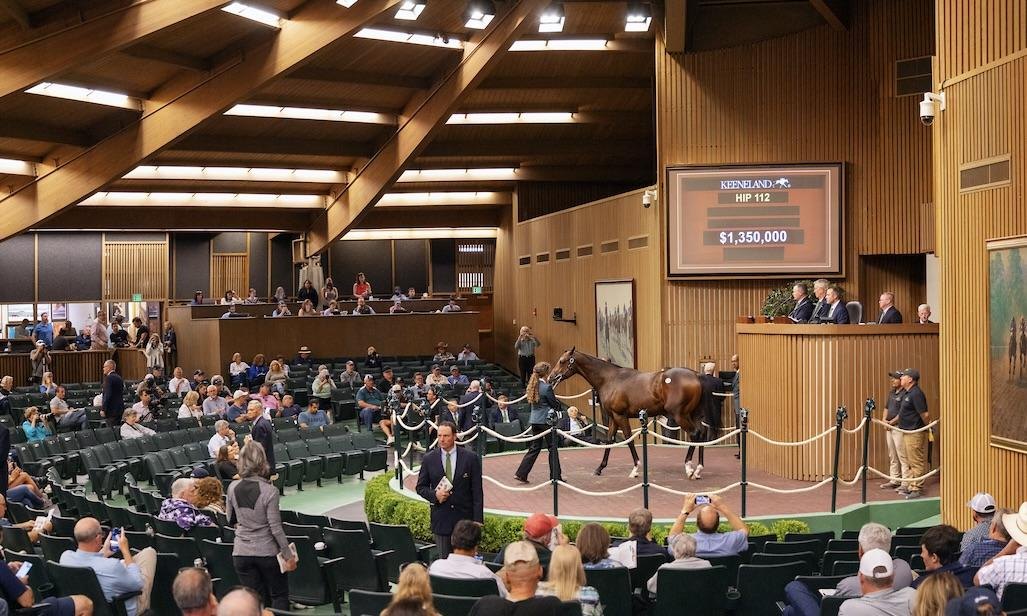
I got to talking with a trainer the other day about how Keeneland September is organized and the extent to which catalog placement shapes the way we think about horses before we ever see them.
Book 1 carries a certain assumption. These are the commercial horses. Fashionable sires, deep female families, strong physicals, the kind of pedigrees the market swoons for, often irrationally. These are also the kinds of prices that can become difficult to justify in a level-headed ROI analysis if the goal is simply to buy racehorses.
As the conversation went on, we got into the difference between commercial perception and what eventually happens on the racetrack.
That raised a pretty simple question:
Which Keeneland September Book has actually produced the most graded stakes winners in recent years?
The intuitive answer is probably Book 1.
Our review points pretty strongly to Book 2.
Book 1 appears to have the highest strike rate. Book 2 appears to have produced the greatest number of individual graded stakes winners.
That distinction is where this gets interesting.
Start with the population
We looked across 15 years of Keeneland September sales, then put the most weight on the cohorts old enough to have had a fair opportunity to race.
Across the full sale universe, Keeneland sold nearly 43,000 horses. More than 1,100 of those graduates have gone on to win a Grade or Group 1, 2 or 3 race.
The newest crops still have most of their racing careers in front of them, so they tell us very little about ultimate production. The useful comparison comes from the mature cohorts.
And across those older crops, a pattern emerges.
Book 2 combines a very high level of commercial selection with a much larger population than Book 1.
That matters more than I initially expected.
Book 1 is a commercial filter
It helps to be precise about what Book 1 represents.
Keeneland is running an auction. Book placement reflects expected commercial demand.
Sire power matters. Female family matters. Physical presentation matters. Fashion matters. The expected buyer pool matters.
All of those things can tell us something about racing potential. They also have an enormous influence on price.
A Book 1 placement is therefore a strong signal about how the market is expected to receive a horse.
It is a much less precise prediction of how good a racehorse that horse will become.
The size of the Books makes that distinction particularly important.
In 2012, Book 1 contained roughly 132 cataloged horses. Book 2 contained about 915.
In 2017, Keeneland again created a highly selective Book 1 with 167 yearlings. Book 2 contained more than 1,000.
The current structure is less extreme, although Book 2 has still generally contained around twice as many horses as Book 1.
Book 2 simply gets a lot more shots.
Book 2 does not need the same strike rate
If Book 2 contains twice as many horses, it can produce graded stakes winners at a meaningfully lower rate and still produce more of them overall.
That appears to be what has happened.
Book 1 is the denser population. If you picked a horse at random from a Book and wanted the highest probability that it would eventually become a graded stakes winner, Book 1 would be the logical choice.
Book 2 gives you something different.
It retains a substantial amount of the quality concentrated at the top of the sale while opening the population considerably.
More horses. More variation. More opportunities for high-level racing ability to show up in a package the commercial market finds a little less obvious.
That combination appears to make Book 2 the largest producer of graded stakes winners in absolute terms.
For a racehorse buyer, that is a meaningful distinction.
Book 1 appears to tell us where graded stakes winners are most concentrated.
Book 2 appears to tell us where there are more of them to find.
The Book labels move
There is one complication worth mentioning.
Keeneland has changed the size and structure of its Books repeatedly.
The 167-horse Book 1 of 2017 represented a much narrower slice of the sale than Book 1 in some other years. The later Books have changed as well.
So the label itself has never represented a perfectly fixed percentile of the September population.
The underlying commercial logic has been more consistent.
The front of the sale concentrates the pedigrees and individuals expected to command the strongest demand. As the sale progresses, more horses carry something the market values less aggressively.
Maybe it is the sire.
Maybe it is the female family.
Maybe the horse needs more time.
Maybe the physical falls outside the fashionable ideal.
Maybe the page has plenty of runners without the kind of black type that gets people excited in the pavilion.
Sometimes that discount is deserved.
Sometimes it creates an opportunity.
Good horses keep coming from deeper in the sale
The later Books continue to produce serious racehorses.
The 2024 racing season provides a useful snapshot.
Book 1 graduates included Arthur's Ride, Leslie's Rose and Newgate.
Book 2 included Dornoch and Randomized.
Book 3 produced Vahva.
Book 4 produced Muth.
Book 5 included Du Jour and Kabirkhan.
Book 6 produced Tuz.
One season is only a snapshot, although the broader point holds across the larger population.
Commercial concentration declines as the sale moves along. High-level racing ability travels much farther down the catalog.
Anyone who spends much time trying to buy racehorses has seen some version of this.
The page is one source of information.
The horse standing at the end of the shank is another.
So is the production record behind the page.
A mare without fashionable black type may still throw runners.
A sibling that earned $180,000 over 35 starts may tell you something useful about soundness and constitution.
A family filled with horses that consistently make it to the races can carry information that gets less attention than a recent Grade 1 winner in bold type.
That information matters when the mandate is to buy a racehorse.

The better question may be price
Once we started looking at which Book produces the most graded stakes winners, another question became more interesting.
Where does Keeneland September offer the best price for a meaningful chance at one?
That requires another layer of work, but the outline of the question is already pretty clear.
Book 1 appears to offer the highest graded stakes strike rate.
It also carries the greatest concentration of commercial expectation and some of the highest prices in the sale.
At some point, another $300,000 or $500,000 spent on sire fashion, pedigree or a highly commercial physical has to earn its way back.
There are plenty of rational reasons for buyers to pay those premiums. Stallion value matters. Broodmare residual matters. Resale matters. Different buyers have different objectives.
If the mandate is primarily to buy a racehorse, the math looks different.
Book 2 appears to offer the greatest absolute supply of graded stakes horses.
Books 3 and 4 are where the next question gets especially interesting.
Those Books bring lower acquisition costs and a wider range of reasons for horses to be commercially discounted.
That creates more room for disagreement with the market.
And that is where value comes from.
You are trying to find the horse with more chance of running than the market is making you pay for.
Maybe that comes from a deep family of durable runners.
Maybe it is a mare who consistently gets foals to the races.
Maybe it is a sire whose commercial reputation has cooled faster than his ability to get racehorses.
Maybe it is a physical that looks more like a racehorse than a sales horse.
Maybe the horse simply needs another six months.
Those are the distinctions that become more important as September moves along.
The opportunity lives in the gap
The Book tells us something useful.
It tells us how Keeneland and the market see the population. It gives us context for pedigree, physical and expected price.
The buying decision still happens one horse at a time.
Keeneland September is organized around commercial expectation.
Racehorse buyers are trying to identify racing ability.
Those two things overlap heavily. They never line up perfectly.
The opportunity lives in that gap.
We started with a simple question: which Keeneland September Book has produced the most graded stakes winners?
The evidence points strongly to Book 2.
Book 1 appears to have the highest strike rate.
The question I care about next is harder, and probably more useful:
Where does the market charge the least for a real chance of buying one?
That is where we are headed next.