
Keeneland September 2026 · Freshman Sires Report Card
Grading the Freshman Sire Class at Keeneland September
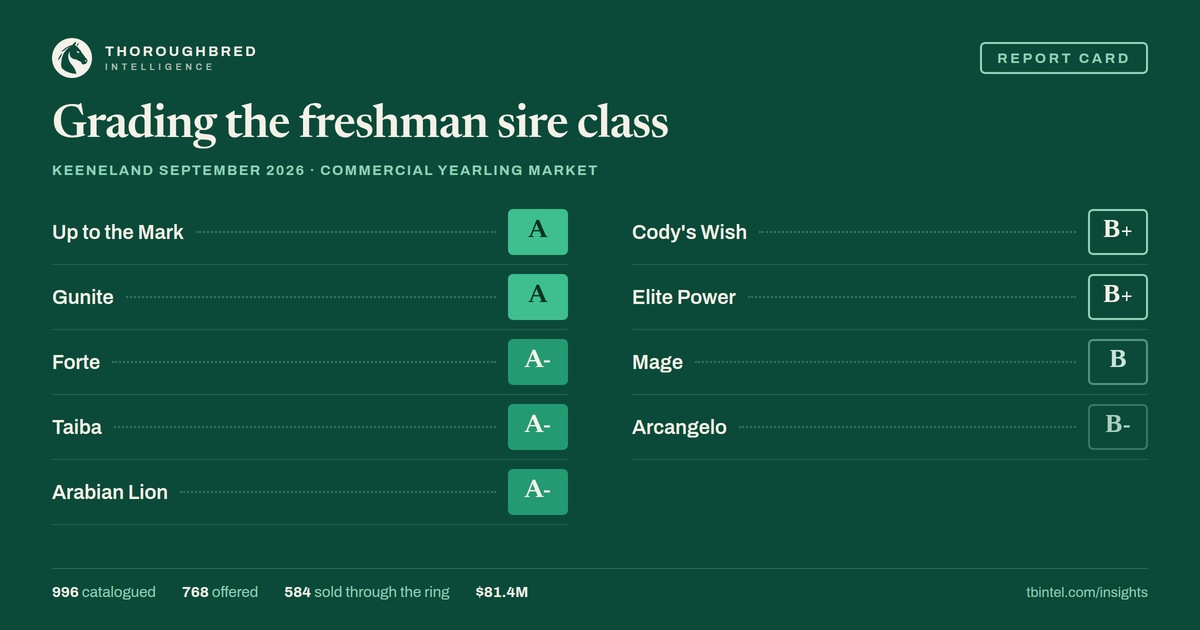
Keeneland cataloged 996 yearlings by these 15 first-crop sires and 584 of them sold through the ring for $81.4 million. The racetrack will deliver a different and far more important grade beginning next year.
Freshman sire season invites overreaction. One expensive yearling can make a stallion look hot. A few RNAs can make him look cold. Keeneland September gives us enough volume to get past some of that noise.
Across the 15 first-crop sires I have been following, Keeneland cataloged 996 yearlings. After withdrawals, 768 went through the ring and 584 sold there for $81.4 million. The range was enormous, from seven-figure horses in the first books to yearlings trading for a fraction of that by the final sessions.
I took an initial look at the class halfway through September. With the sale complete, we have a much better picture.
Cody's Wish produced the highest median among the larger groups, while buyers passed on a meaningful share of his yearlings. Up to the Mark finished with a lower median and exceptional clearance. Gunite had more horses to absorb than anyone in this group and finished with the most gross. Forte quietly built one of the steadiest markets in the class.
The grades below are commercial yearling-market grades, based on price, liquidity, depth, catalog position and sample size. I also included each stallion's advertised 2024 stud fee because these yearlings were conceived during that breeding season. The fee provides useful context for breeders. It plays no role in the grade.
The Commercial Grades
| Sire | Grade | 2024 Fee | Offered | Ring sold | Initial RNA | Median | Gross |
|---|---|---|---|---|---|---|---|
| Up to the Mark | A | $25,000 | 57 | 49 | 14.0% | $120,000 | $9.58M |
| Gunite | A | $35,000 | 94 | 72 | 23.4% | $130,000 | $12.69M |
| Forte | A- | $50,000 | 72 | 55 | 23.6% | $180,000 | $10.70M |
| Taiba | A- | $35,000 | 75 | 59 | 21.3% | $100,000 | $8.36M |
| Arabian Lion | A- | $30,000 | 49 | 42 | 14.3% | $75,000 | $4.23M |
| Cody's Wish | B+ | $75,000 | 61 | 37 | 39.3% | $285,000 | $12.05M |
| Elite Power | B+ | $50,000 | 84 | 59 | 29.8% | $100,000 | $9.19M |
| Annapolis | B+ | $12,500 | 33 | 27 | 18.2% | $50,000 | $2.18M |
| Mage | B | $25,000 | 60 | 43 | 28.3% | $65,000 | $4.29M |
| Two Phil's | B | $12,500 | 30 | 25 | 16.7% | $35,000 | $1.54M |
| Pappacap | B | $12,500 | 36 | 28 | 22.2% | $38,500 | $1.29M |
| Arcangelo | B- | $35,000 | 46 | 34 | 26.1% | $46,000 | $3.09M |
| Proxy | B- | $25,000 | 30 | 23 | 23.3% | $37,000 | $1.07M |
| Loggins | B- | $7,500 | 19 | 15 | 21.1% | $30,000 | $560K |
| Dr. Schivel | C+ | $12,500 | 22 | 16 | 27.3% | $28,000 | $567K |
Through-ring results. Offered excludes withdrawals. Initial RNA rate measures the result at the hammer, so horses subsequently sold privately remain RNAs for this comparison. The 2024 fee is the advertised fee for the breeding season that produced these yearlings and is included for reference only.
The Stud Fees Add Another Layer
Stud fee answers a different question from the grade. The grade tells us how the yearling market received the sire. The fee gives breeders some context for where the commercial proposition started.
The economics go well beyond the advertised fee. Mare value matters enormously. So do discounts, foal shares, board, veterinary work, sales preparation and commissions. Still, the starting fee helps put the yearling prices in perspective.
Up to the Mark entered stud at $25,000 and produced a $120,000 September median while clearing 86 percent of his offered yearlings through the ring. Cody's Wish started at $75,000, the highest introductory fee in this group, and still produced a $285,000 median. Forte's $180,000 median came from a $50,000 introductory fee and a market that remained fairly liquid across the sale.
Among the smaller groups, Annapolis deserves some attention. He entered stud at $12,500, produced a $50,000 median and sold 27 of 33 offered.
Arcangelo gives us the other side. He stood for $35,000 and finished September with a $46,000 median. His yearlings found buyers, but the larger sample ultimately settled much closer to the original breeding fee than his early select-book results suggested.
These relationships are context rather than ROI. They tell us something useful about how the market valued the first crop relative to where breeders started.
Up to the Mark: A
If I were looking for the cleanest combination of price, liquidity and breadth, I would start with Up to the Mark.
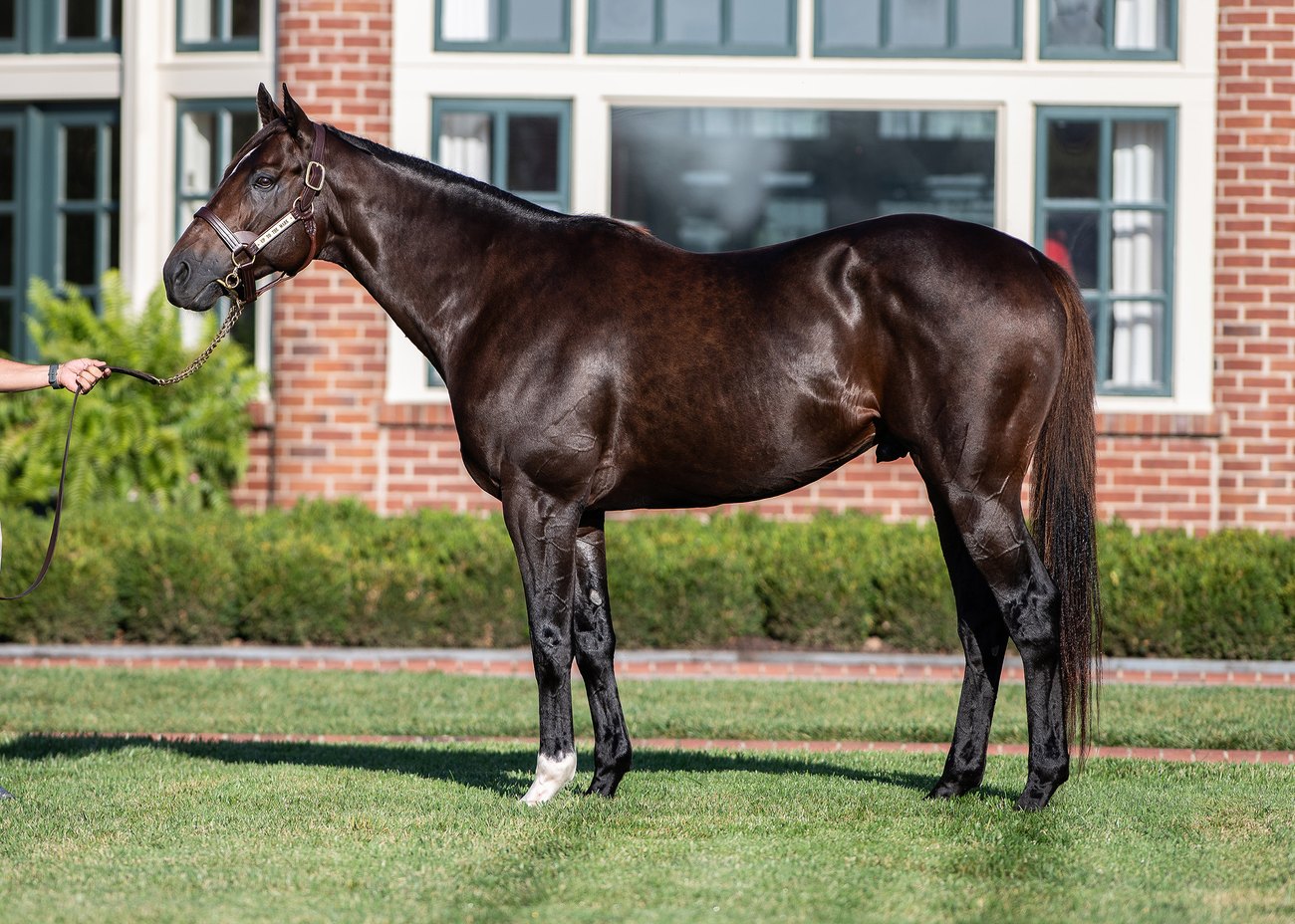
Through Book 3, 25 had been offered and 21 sold, with a $250,000 median and a 16 percent initial RNA rate. Another 32 appeared in Books 4 through 6 and 28 sold. The median came down to $80,000 as the catalog moved deeper, while the initial RNA rate improved to 12.5 percent.
For the full sale, 49 of 57 sold through the ring and generated $9.58 million.
There was also a real ceiling. Hip 646, the colt out of Inchargeofme, brought $1.65 million, the only seven-figure yearling among the freshmen we were following.
The filly market may be the more interesting statistic. Twenty-nine Up to the Mark fillies went through the ring during September and all 29 sold. Their median was $150,000.
From a $25,000 introductory fee, breeders got a first crop that buyers supported at several price levels, in both sexes and across the catalog.
Gunite: A
Gunite gets the same grade through a different route.
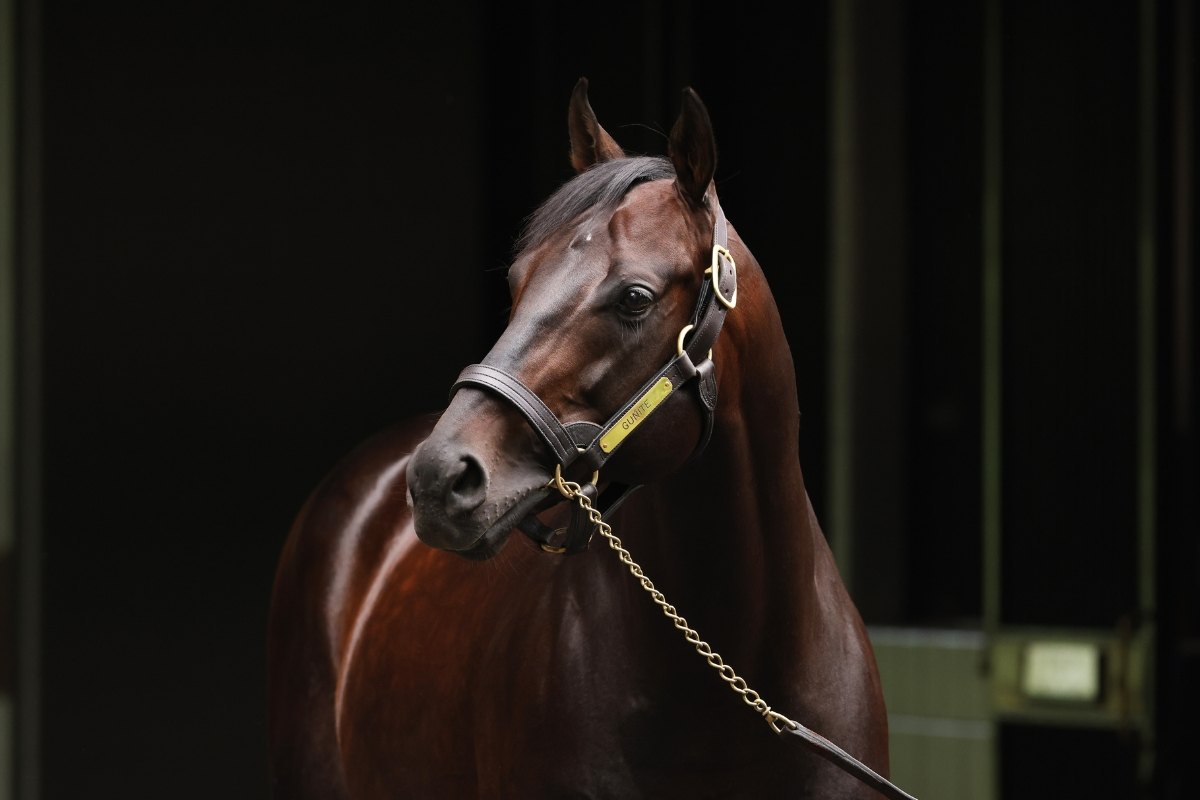
He had the largest commercial workload in this group. Ninety-four yearlings went through the ring and 72 sold for $12.69 million, the highest through-ring gross among the freshmen we tracked.
Through Book 3, 47 Gunites had been offered and 35 sold at a $200,000 median. Keeneland then gave him another 47 in Books 4 through 6, and 37 sold. The median stepped down to $100,000, while the initial RNA rate improved from 25.5 percent in the first half to 21.3 percent in the second.
His full-sale median finished at $130,000, and the ceiling held up as well. A Book 2 Gunite brought $725,000 and a Book 3 horse brought $700,000.
Gunite had already established a healthy weanling market last November, when 29 of 33 sold at a $155,000 median. September asked buyers to absorb a much larger population across a much wider range of yearlings. The group handled it.
Forte, Taiba and Arabian Lion: A-
These three arrived at the same grade from different directions.
Forte was boring in the best possible way
Forte's market behaved almost exactly the way I would want a young sire market to behave.
His Keeneland November weanlings had a $200,000 median. Through Book 3, his September median was still $200,000, with 37 of 50 offered selling through the ring.
The later books stayed solid. Eighteen of 22 sold in Books 4 through 6, with a $100,000 median and an 18.2 percent initial RNA rate.
He finished September with 55 sales from 72 offered, a $180,000 median, a $194,545 average and $10.7 million in gross. There were flashier freshmen. Few were steadier.
Taiba got better as September went along
Taiba's early market carried more friction. Through the first three books, his median had jumped from $125,000 at Keeneland November to $225,000, while the initial RNA rate reached 30 percent.
The second half was considerably cleaner. Forty-five Taibas were offered in Books 4 through 6 and 38 sold, an initial RNA rate of 15.6 percent. Their median was $67,500.
Book 2 and Book 5 ask buyers to evaluate very different horses. I read the shift as evidence of where Taiba's broader market found its footing rather than a simple response to lower prices.
He finished with 59 of 75 offered selling through the ring, an overall RNA rate of 21.3 percent and $8.36 million in gross.
Arabian Lion kept getting them sold
Arabian Lion remains the freshman I think an average-price leaderboard underrates.
Last November, 27 weanlings were offered and 18 sold at a $70,000 median, with a 33 percent initial RNA rate. Through Book 3 at September, 14 of 16 had sold and the median had reached $160,000.
As more horses arrived in the later books, the full-sale median settled at $75,000. The liquidity stayed excellent.
Forty-nine Arabian Lions went through the ring. Forty-two sold. His 14.3 percent initial RNA rate was essentially identical to Up to the Mark's and among the best of the major groups.
There are freshmen with much prettier averages. Very few were easier to sell.
Cody's Wish: B+
Cody's Wish may be the most interesting grade in the group because price and liquidity tell such different stories.
His 37 through-ring sales averaged $325,757 with a $285,000 median, both the highest among the larger groups. Twenty-six of those 37 brought at least $250,000 and seven reached $500,000. His $12.05 million gross trailed only Gunite.
Those prices came from the most expensive starting point in the class. Cody's Wish entered stud at $75,000, and the yearlings buyers wanted supported that fee impressively.
The rest of the draft was a much tougher market. Sixty-one went through the ring and 24 failed to sell initially, a 39.3 percent RNA rate. Five later changed hands privately.
Only seven Cody's Wishes appeared after Book 3, so September gave us relatively little information about a deeper commercial floor. Three of those seven sold at a $160,000 median.
For breeders, Cody's Wish offered the largest median in the class and one of its most selective markets.
Elite Power: B+
Elite Power also developed two markets, although his split was more about price level.
Through Book 3, his successful yearlings averaged $237,576 with a $190,000 median and an $800,000 top. The initial RNA rate had reached 35.3 percent.
The second half clarified the floor. Twenty-six of 33 offered in Books 4 through 6 sold, while the median on those horses came down to $41,000.
For the full sale, 59 of 84 sold through the ring for $9.19 million, with a $100,000 median.
Elite Power could clearly produce a yearling buyers valued at several hundred thousand dollars. His broader population also found buyers deeper in September, at a much lower price point. That spread between ceiling and floor defined his first yearling market.
Mage: B
Mage is where the full-sale sample changed the picture most.
Through Book 3, 26 had gone through the ring and 12 sold, leaving an initial RNA rate of 53.8 percent. The successful horses had a $140,000 median, but transactions were hard to complete.
The later books gave us a very different market. Book 4 produced 12 sales from 14 offered. Book 5 produced 13 from 14. All six offered in Book 6 sold.
From Book 4 through the end of the sale, 31 of 34 Mages sold through the ring. The first three books cleared 46 percent. The next three cleared 91 percent.
Nine of Mage's RNAs also subsequently sold privately, so 52 of 60 offered eventually had a reported buyer.
His full-sale median finished at $65,000. The better-placed yearlings encountered substantial resistance at six-figure expectations. Deeper in the catalog, buyers took the horses home very readily.
Mage ended September with a much healthier commercial market than the first three books suggested, just at a considerably lower price point.
Arcangelo: B-
Arcangelo is the best reminder in this group about sample size.
Through Book 3, six yearlings had sold at a $250,000 median. His Keeneland November weanlings had carried an $85,000 median. On the surface, it looked like one of the largest repricings in the class.
The rest of September supplied 28 more sales, and those later horses had a $40,000 median.
Across the complete sale, 34 of 46 offered Arcangelos sold through the ring at a $46,000 median and $91,000 average. Seven additional RNAs subsequently sold privately.
His $35,000 introductory fee adds useful perspective. The full-sale median ended up only modestly above the advertised breeding fee before considering the mare, carrying costs and sales expenses.
The liquidity was respectable. The larger sample simply gave us a very different commercial benchmark from the first six sales.
Gun Runner's Sons Deserve Their Own Note
Gunite, Taiba and Pappacap collectively had 205 yearlings offered through the ring. Buyers took 159 of them for $22.34 million, with a combined initial RNA rate of 22.4 percent.
Gunite operated at the highest level and handled the most volume. Taiba showed a strong front end and became easier to transact deeper in the sale. Pappacap sat much farther down the price curve, finishing with 28 sales from 36 offered and a $38,500 median.
Gun Runner's own rise through the Keeneland market has been one of the dominant sire stories of the last several years. His first sons at stud just gave buyers their first large-scale chance to decide whether some of that commercial appeal travels down another generation.
The early commercial evidence is encouraging.
The Smaller Groups
The smaller samples deserve lighter treatment, though several are worth following.
Annapolis stands out. He finished September with 27 sales from 33 offered, an 18.2 percent initial RNA rate and a $50,000 median from a $12,500 introductory fee.
His B+ sits above Mage's B because the commercial grade rewards the market actually achieved across the full sale. Annapolis cleared 81.8 percent of his offered yearlings through the ring with relatively little friction. Mage's later books were excellent, but his full-sale initial RNA rate still finished at 28.3 percent. The stud fee makes Annapolis's result more interesting for breeders, but it plays no role in the grade.
Two Phil's also cleared well, selling 25 of 30 at a $35,000 median. Pappacap sold 28 of 36 at $38,500.
Loggins reached a $30,000 median from 15 sales, Proxy finished at $37,000 from 23, and Dr. Schivel at $28,000 from 16. Those groups give us useful first benchmarks. Another crop and another sale will tell us considerably more.
What the Market Told Us
An average-price leaderboard misses a lot of what happened here.
Up to the Mark and Arabian Lion built the easiest major markets to transact. Gunite showed the most depth under heavy supply. Forte and Taiba gave breeders broad, functional markets at substantial price points. Cody's Wish showed how far apart price and liquidity can get, with buyers paying heavily for the horses they wanted and passing on plenty of others. Elite Power developed a valuable upper end with a much lower floor underneath it.
The stud fees add another useful layer. Up to the Mark's first crop looks particularly strong from a $25,000 starting point. Cody's Wish supported the highest introductory fee in the class with elite prices on the horses buyers wanted. Forte combined a $50,000 fee with a $180,000 median and solid liquidity. Annapolis may be the quieter breeder-economics story among the smaller groups.
Next year, the horses get to start grading the stallions themselves.
Methodology. Thoroughbred Intelligence analyzed the final Keeneland September 2026 catalog at the hip level for the same first-crop sires followed in the earlier analysis. Across those 15 sires, 996 yearlings were cataloged, 228 were withdrawn, 768 were offered and 584 sold through the ring for $81.38 million. Offered excludes withdrawals. Sold, average, median, gross and top price use through-ring transactions. Initial RNA rate preserves subsequent private sales as RNAs, measuring the result when the horse stood in the ring. Books are consecutive session pairs, with Book 1 covering sessions 1 and 2 and the sixth pair covering sessions 11 and 12. Keeneland labelled that final pair Book 6 through 2024 and renamed it Book 5B in 2025, so this analysis uses consecutive session pairs throughout to keep the years comparable.
The grades measure the commercial yearling market only and use price, liquidity, depth, catalog position and sample size. Racing performance is outside the grade.
The 2024 advertised stud fees correspond to the breeding season that produced these yearlings. They are included as reference information and play no role in the grades. Actual breeder economics can differ materially because of mare value, discounts, foal shares, board, veterinary expense, sales preparation, commissions and other costs.