
The Justify Disconnect
His yearlings are getting harder to sell in America even as his racing record, mare quality and international profile keep strengthening.
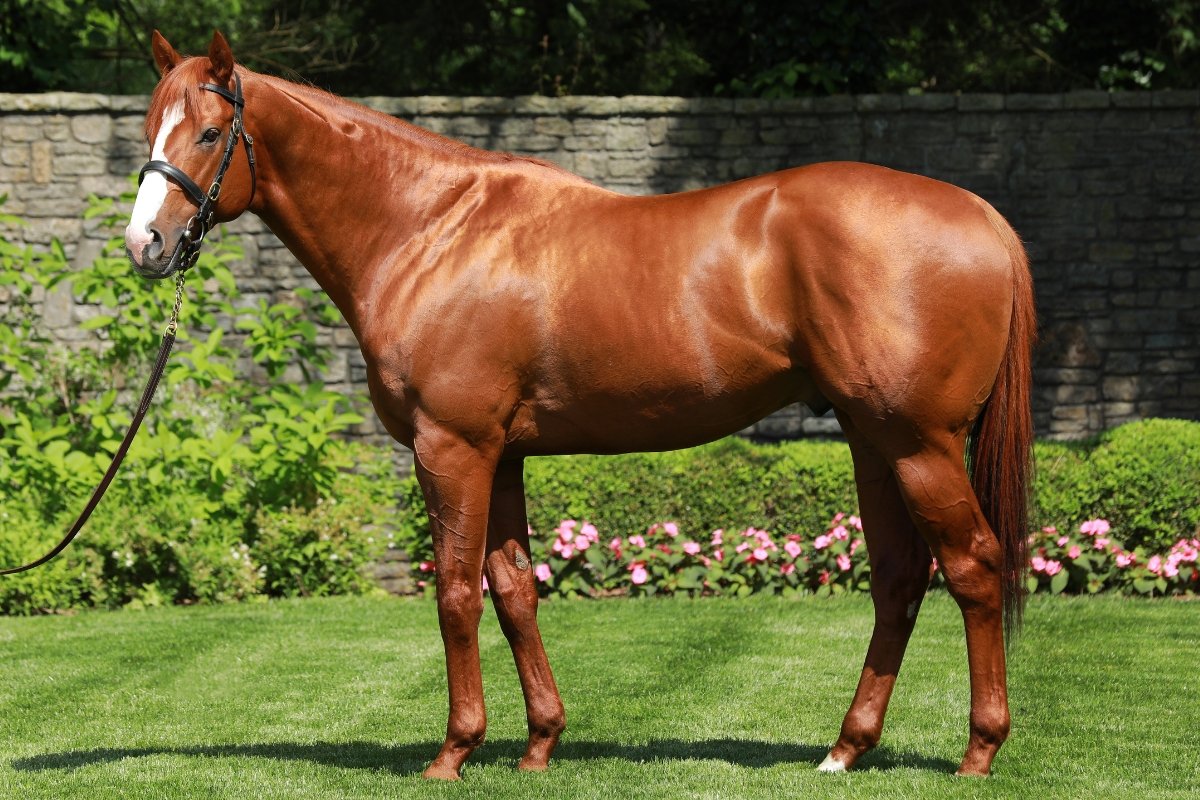
Justify has always been something of an enigma to me. Despite maintaining elite pricing and elite stature since retiring to Ashford, I have never felt he gets quite the same treatment in the American sire conversation as Gun Runner, Into Mischief or, more recently, Not This Time.
Maybe that is perception on my part. Maybe the American market sees something I am missing. Or maybe we are still figuring out what kind of sire Justify actually is.
That question came back to me while we were going through the first two books of Keeneland September. His yearling results have followed the same pattern for four straight years: prices keep rising and clearance keeps falling.
That made us curious whether the Keeneland results were really about Justify, or about how the American market is valuing him. We went back through his racing record, looked more closely at where his best runners are succeeding and then reviewed the quality and composition of his mare books. Taken together, those pieces started to explain why the sale results look so unusual.
The Keeneland Pattern
In 2023, 44 Justifys were offered in Books 1 and 2. Thirty-six eventually sold, an 82 percent sale rate, for an average just under $300,000.
This year, 60 were offered and 39 are currently reported sold. The average reached $476,282 while the sale rate fell to 65 percent.
| Year | Offered | Reported sold | Sale rate | Average | Median |
|---|---|---|---|---|---|
| 2023 | 44 | 36 | 81.8% | $299,861 | $267,500 |
| 2024 | 40 | 31 | 77.5% | $368,871 | $300,000 |
| 2025 | 47 | 32 | 68.1% | $394,375 | $350,000 |
| 2026 | 60 | 39 | 65.0% | $476,282 | $350,000 |
His average is up almost 59 percent in three years. His sale rate is down almost 17 points.
The number offered has increased 36 percent. The number sold has increased by three horses.
More Justifys are arriving at the front of September, and buyers are becoming more particular about which ones they take home.
Figure 1 · The disconnect
The price goes up, the clearance goes down
Show the data
| Year | Offered | Reported sold | Sale rate | Average | Median |
|---|---|---|---|---|---|
| 2023 | 44 | 36 | 81.8% | $299,861 | $267,500 |
| 2024 | 40 | 31 | 77.5% | $368,871 | $300,000 |
| 2025 | 47 | 32 | 68.1% | $394,375 | $350,000 |
| 2026 | 60 | 39 | 65.0% | $476,282 | $350,000 |
The Average Needs Some Help
Three Justifys brought at least $1 million in the first two books this year after none reached seven figures through the same point last year. Take those three out and the remaining 36 reported sales averaged about $398,000, almost exactly where his entire Week 1 group averaged in 2025.
The median stayed at $350,000. Most of the increase in this year's average came from the top of the draft.
Book 1 makes the split especially clear. Thirty-one Justifys were offered there this year. Sixteen sold through the ring for a $728,125 average and a $650,000 median, with four more later appearing as reported sales.
Book 2 was a different market. Nineteen are currently reported sold for a $315,000 average and a $300,000 median.
The RNA bids add useful context. The remaining Book 2 Justifys had a median reported bid of approximately $305,000, essentially the same as the median successful sale.
There is plenty of money around $300,000 for these horses. Sellers are frequently arriving at a different answer.
The fillies make the picture even more curious. Twenty-seven Justify colts were offered in Books 1 and 2 this year and 21 are currently reported sold, about 78 percent. Thirty-three fillies were offered and 18 sold, about 55 percent.
The fillies that sold averaged approximately $494,000, higher than the $461,000 average for the colts. In Book 2, 12 of 13 colts sold and seven of 16 fillies sold.
Physicals, vetting, reserves and female family all sit inside those numbers, so the sale results cannot explain the gap by themselves. They do show that buyers are making fairly hard distinctions within the Justify population.
Follow the Mares
Justify entered stud with about as much support as a young stallion could receive. He covered 252 mares in his first season in 2019 and another 222 in 2020. His book then followed the familiar young-sire cycle and fell to 156 mares by 2022, the year his first runners reached the track. (Daily Racing Form)
Those first runners changed the conversation quickly. By the end of 2023 he had City of Troy and Opera Singer in Europe, Just F Y I and Hard to Justify at the Breeders' Cup, along with Arabian Lion and Aspen Grove at Grade 1 level. His book began filling again. (Daily Racing Form)
The real change came in 2024.
Equineline reported 263 mares covered to Northern Hemisphere time, while The Jockey Club's current live-foal report lists 285 total covers when 22 Southern Hemisphere-time mares are included. Justify ranked second in North America by Northern Hemisphere book size that year. (The Jockey Club)
The size of the book matters. The composition matters more.
Coolmore Has Not Been Dabbling
Fifty-seven daughters of Galileo went to Justify in 2024.
Among them were Alice Springs, Clemmie, Found, Love, Magical, Minding, Rhododendron, Tuesday, Warm Heart and Winter. Together Forever, the dam of City of Troy, went back as well. Other Galileo mares included Best In The World, the dam of Snowfall, and Irish Oaks runner-up Toy. (BloodHorse)
Coolmore also sent or participated in mares such as Abel Tasman, Bellafina, Campanelle, Fancy Blue, Gamine, Legatissimo, Mother Earth, Newspaperofrecord, Rushing Fall and Samaready. Godolphin, Juddmonte and the Aga Khan Studs supported him too, while the American group included mares such as Malathaat, Dunbar Road, Regal Glory, Sharing, Spendarella, Uni and Pizza Bianca. (BloodHorse)
Coolmore has not been dabbling with Justify and Galileo. It has built a substantial homebred population around the cross, using some of the best mares in its broodmare band.
That is important to this story because the racing success came first. City of Troy showed what Justify could do with a Galileo mare, and Coolmore responded by sending him 57 more daughters of Galileo in a single season.
Those matings are yearlings now.
The 2026 Keeneland crop is therefore the first yearling crop from a major post-proof upgrade in Justify's mare quality.
More of them reached Book 1. Three made at least $1 million. The Week 1 average climbed to $476,282.
The median remained $350,000 and the sale rate fell to 65 percent.
That is where seller economics become relevant.
The Cost Basis Changed Too
The yearlings selling this September were conceived when Justify's advertised fee moved from $100,000 to $200,000.
Last year's Week 1 crop, conceived at $100,000, produced a $350,000 median. This year's group, conceived at $200,000, produced the same median.
That is crude math. Shares, foal shares, negotiated seasons, mare values, carrying costs, prep and commissions all affect the actual economics.
Still, the basic point is useful. A seller looking at a $300,000 bid on a yearling conceived on a $200,000 season and out of a better mare is making a different calculation.
That may explain a meaningful part of the declining clearance. The Book 2 results certainly fit the possibility. Sellers were turning down bids around $305,000 in a population where the median successful transaction was $300,000.
Breeder expectations may simply have moved faster than the middle of the yearling market.
The racetrack gives us another reason to avoid treating the lower clearance as a simple loss of confidence in Justify.
The Runners Are Making a Strong Case
Through September 19, Justify had 162 runners in BloodHorse's 2026 North American sire statistics. Fourteen were black-type winners and 28 had won or placed in a black-type race.
That works out to 8.6 percent black-type winners and 17.3 percent black-type horses from runners. He had six graded stakes winners, including two Grade 1 winners.
Those percentages compare very well with the major sires around him.
| Sire | Black-type winners | Black-type horses |
|---|---|---|
| Justify | 8.6% | 17.3% |
| Not This Time | 6.8% | 14.6% |
| Into Mischief | 5.5% | 12.1% |
| Gun Runner | 5.3% | 12.1% |
| Nyquist | 4.9% | 8.5% |
| Constitution | 3.5% | 10.8% |
His broader Northern Hemisphere Stallion Register record includes 58 black-type winners and 26 graded black-type winners from his first five crops of racing age.
The American results are strong on their own.
Europe is where the stallion becomes harder to put into a familiar box.
Europe Changes the Question
BloodHorse currently ranks Justify first among North American-based stallions by 2026 European progeny earnings.
The European population remains small, with 28 runners on the current table. Three are black-type winners, two are Group winners and one is a Group 1 winner.
Their average winning distance is 10.36 furlongs.
His North American runners are winning at an average of 7.73 furlongs.
The horses behind the European numbers are already familiar. City of Troy won the Derby, Eclipse and Juddmonte International. Ruling Court won the 2,000 Guineas. Scandinavia won the St Leger. Opera Singer won the Prix Marcel Boussac at two and the Nassau at three. (Racing Post)
Justify has already sired winners of the 2,000 Guineas, Derby and St Leger from his early crops.
The pedigrees behind those horses are equally interesting. City of Troy and Scandinavia are out of Galileo mares. Opera Singer is out of a Sadler's Wells mare. Ruling Court is out of a High Chaparral mare.
The Justify-Galileo cross has produced seven black-type winners from 66 runners, an 11 percent stakes-winner rate. (Racing Post)
There is a straightforward breeding idea behind it. Justify supplies speed, power and the ability to carry that speed around two turns. Galileo and the wider Sadler's Wells line bring generations of turf and Classic-distance aptitude.
The results have been good enough for Coolmore to keep applying the idea at considerable scale.
Australia adds another piece. Justify's Southern Hemisphere Stallion Register record includes nine graded black-type winners.
By now, the racing record looks genuinely global.
What Exactly Is the American Market Buying?
That brings the question back to Keeneland.
Buyers at the front of September have a fairly clear commercial target. Dirt ability matters. Enough speed and development to make the important juvenile races matters. With colts, future stallion potential can add enormous value.
Justify can produce that horse. His best yearlings leave little doubt about it.
His runners also show a much wider range. Europe is getting Classic turf horses from him over longer distances. Australia has produced major runners. His American progeny continue to generate black type at a high rate.
That may help explain why the market is making such sharp distinctions within his yearling drafts. Some Justifys may fit the American commercial target immediately. Others may make more sense to buyers thinking about turf, distance or later development.
We would need physical evaluations and a deeper horse-by-horse study to take that idea much farther. The sale results cannot tell us what an RNA looked like standing outside the barn.
There is one small piece of data worth following. In our 2026 Books 1 and 2 sample, the Justifys out of Galileo, Frankel and Gleneagles mares sold at materially lower prices than the rest of his population, with almost identical clearance.
There were only 11 horses in that group, so it is far too small to make a broad claim. Given what Justify is doing with those lines on the racetrack in Europe, I want to keep watching it.
The Best Books Have Barely Reached the Track
This may be the most interesting part of the whole story.
The runners that established Justify came largely from the books breeders sent him while they were still waiting for proof. His book had fallen to 156 mares by 2022. Those early crops produced enough evidence for breeders to come back in force. (Daily Racing Form)
The 2024 book, with 57 Galileo mares and support from some of the best breeding programs in America and Europe, is only a yearling crop today.
Those horses race at two next year. Their Classic season is 2028.
Breeder confidence remained high in 2025, when Justify covered 244 mares at a $250,000 advertised fee, the fourth-largest book reported in North America. (The Jockey Club)
So much of the racing evidence we are using to evaluate Justify today comes from books that were assembled before breeders had seen his best work.
The strongest mare books of his career are still coming.
So What Is Justify?
I started with a simple question: is Justify misunderstood by the American market, or am I misunderstanding Justify?
I am still not sure misunderstood is the right word.
The American yearling market has good reasons to be selective. The cost basis behind these horses has risen dramatically. More Justifys are being placed in Book 1. Seller expectations have moved with the stud fee and the mare quality. Every individual still has to satisfy buyers choosing among yearlings by Gun Runner, Into Mischief, Not This Time, Nyquist and the rest of the elite sire population.
What does seem clear is that "American dirt sire" has become too narrow a description.
Justify is producing high-level dirt horses in America, European Classic winners on turf and major horses in Australia. Coolmore has responded by committing some of the best mares in its program to him, including an extraordinary concentration of Galileo daughters. Other major international breeders have done the same.
The most ambitious version of that breeding strategy has barely reached the sales ring.
At Keeneland, meanwhile, his sale rate has fallen from 82 percent to 65 percent over four years.
That is the Justify disconnect.
The American market is getting more selective with his yearlings at the same time breeders are giving him better mares and his runners are proving increasingly versatile around the world. Some of the explanation probably sits in the higher cost basis and higher reserves. Some may sit in the kind of horse American buyers want from him.
The next two crops should tell us much more.
Thoroughbred Intelligence analyzed hip-level Keeneland September Books 1 and 2 results from 2023 through 2026. Reported sale rate includes identifiable post-sale transactions and excludes withdrawals. Mare-book history uses reported covers from The Jockey Club and Equineline. Racing statistics are current through September 19, 2026. Sale data, racing performance and mare quality measure different parts of the stallion market and are considered separately throughout this analysis.