
Keeneland September 2026 · Sire Analysis
What a Record September Says About the Commercial Sire Market
Keeneland September is a commercial referendum on the sire market. This year the incumbents held their ground, but a few challengers moved closer, Yaupon forced his way into elite company, and the concentration of money at the top continues to grow.
One of my favorite things about Keeneland September is that it serves as a commercial referendum on the sire market.
By the end of the sale, nearly every important commercial stallion has had his turn in front of buyers. We get to see how firmly the incumbents still control the market, whether a younger sire is moving into their territory, who has been re-rated, who suddenly has momentum and where buyers have become more selective.
It is also a good place to separate reputation from what people are actually willing to pay.
This year produced plenty to work with.
Gun Runner again generated more money than any other sire, although Not This Time came remarkably close. Into Mischief needed only 40 sales to produce more than $30 million. Nyquist put together one of the best combinations of price and liquidity in the sale. Flightline and Life Is Good, who entered stud the same year, produced two very different but successful commercial markets. Justify remained expensive and unusually selective.
And then there was Yaupon, whose yearlings were conceived on a $25,000 fee and somehow ended up ninth on a gross leaderboard otherwise populated by stallions who stood for at least $85,000.
Farther down, Army Mule, Girvin and Vekoma gave us another way to look at the sale: how quickly can the yearling market move relative to the breeding shed, and who actually captures that move when it happens?
Before getting into any of them, though, one big number caught my attention.
The top 10 sires accounted for $273.7 million, or 49 percent of reported gross, from only 544 of the 3,033 reported sales.
Eighteen percent of the horses took almost half the money. While the sale has been trending toward this lopsidedness for a while, this is the highest concentration yet.
Half the money went to 18 percent of the horses
A sale this expensive is always going to concentrate money among elite stallions. I wanted to know whether 49 percent was actually unusual or simply what September looks like when you add it all up.
Over the previous two sales, it was unusual.
| Year | Top 10 sire gross | Total sale gross | Top 10 share of gross | Top 10 share of horses sold |
|---|---|---|---|---|
| 2024 | $199.0M | $427.8M | 46.5% | 19.7% |
| 2025 | $231.3M | $531.5M | 43.5% | 15.9% |
| 2026 | $273.7M | $558.3M | 49.0% | 17.9% |
Reported sales, including identifiable post-sale transactions. Total sale gross uses Keeneland's final reported figures.
The direction was familiar. The size of the jump from last year was more notable.
Keeneland's reported gross increased by about $26.8 million from 2025. The top 10 sire groups increased by about $42.4 million.
So the top 10 gained substantially more than the entire sale did. Everything outside those 10 sire groups, taken together, generated roughly $15.6 million less gross than it did a year ago.
More supply does not explain it. The top 10 represented a larger share of the horses sold in 2024 than they did this year, yet captured a smaller share of the money. In 2026, buyers simply paid much more for the sire groups they wanted.
The million-dollar market was tighter still. Seventy yearlings brought at least $1 million, and 66 of them were by the top 10 sires. The top five alone produced 54 of the 70 and generated $176.6 million, almost 32 percent of the entire sale.
Last year's market looks different in hindsight. Spending broadened in 2025. This year it moved sharply back toward a relatively small group of stallions.
Here are the 10.
| Rank | Sire | 2024 fee | Sold | Clearance | Average | Median | Gross | $1M+ |
|---|---|---|---|---|---|---|---|---|
| 1 | Gun Runner | $250,000 | 57 | 85.1% | $766K | $525K | $43.67M | 15 |
| 2 | Not This Time | $150,000 | 56 | 86.2% | $730K | $600K | $40.87M | 12 |
| 3 | Nyquist | $85,000 | 59 | 89.4% | $526K | $400K | $31.02M | 8 |
| 4 | Flightline | $150,000 | 52 | 81.3% | $594K | $468K | $30.90M | 8 |
| 5 | Into Mischief | $250,000 | 40 | 78.4% | $753K | $613K | $30.11M | 11 |
| 6 | Life Is Good | $85,000 | 70 | 94.6% | $348K | $300K | $24.39M | 2 |
| 7 | Uncle Mo | $150,000 | 62 | 87.3% | $385K | $300K | $23.88M | 4 |
| 8 | Justify | $200,000 | 49 | 71.0% | $417K | $310K | $20.44M | 3 |
| 9 | Yaupon | $25,000 | 57 | 87.7% | $258K | $225K | $14.69M | 0 |
| 10 | Good Magic | $125,000 | 42 | 79.2% | $327K | $220K | $13.73M | 3 |
Reported sales, including identifiable post-sale transactions. Clearance is reported sales divided by horses offered, excluding withdrawals. The 2024 fee is the advertised fee for the breeding season that produced these yearlings.
Gross naturally rewards supply, so I would not read this as a ranking of the 10 best sire performances. The rest of the table is more interesting than the ranking itself.
Good Magic rounds out the group with 42 sales, a $220,000 median and $13.7 million in gross. His result was solid rather than surprising, which is probably the right way to think about a sire whose commercial level is already well established.
Gun Runner and Not This Time are getting awfully close
Gun Runner still owns the headline.
Fifty-seven reported sales generated $43.7 million. Fifteen sold for at least $1 million, more than any other sire. His average was $766,000 and his median $525,000.
There was also real depth underneath the seven-figure horses. Twenty-nine Book 1 Gun Runners sold at a $700,000 median. Twenty more sold in Book 2 at $437,500, and seven in Book 3 at $400,000.
Gun Runner's commercial story is no longer about scarcity. There were 67 offered this year. Buyers had choices.
The only sire who really threatened him was Not This Time.
He had one fewer reported sale, 56, and finished less than $3 million behind Gun Runner at $40.9 million. His median was higher at $600,000, clearance slightly better at 86.2 percent, and 12 reached seven figures.
The breeding shed has been catching up to the sale ring for a while. Not This Time stood for $150,000 when these yearlings were conceived, moved to $175,000 in 2025 and is $250,000 for 2026. His book grew from 192 mares in 2024 to 214 last year, while our broader 2025 yearling data showed a $575,000 median.
Gun Runner has been sitting at the top of this market for several years. Not This Time has been climbing toward him.
September did not settle the comparison, but it made it difficult to ignore.
Into Mischief did it with 40 horses
Into Mischief finished fifth by gross.
That sounds almost ordinary until you look at how he got there.
Only 51 were offered and 40 sold. Gun Runner sold 57, Not This Time 56, Nyquist 59, Flightline 52 and Life Is Good 70.
Into Mischief still generated $30.1 million.
His $612,500 median was the highest among the top 10, and 11 of his 40 reported sales brought at least $1 million. More than one in four.
All 51 offered Into Mischiefs were in Books 1 through 3. Fifteen Book 1 sales produced an $825,000 median. Sixteen in Book 2 had a $587,500 median. Nine more sold in Book 3 at $300,000.
His 78.4 percent clearance was lower than Gun Runner, Not This Time and Nyquist, so buyers were hardly indiscriminate. But when an Into Mischief cleared whatever physical, veterinary and pedigree bar they had set, the bidding could get very high very quickly.
There is not much discovery left in the Into Mischief story. Breeders and buyers have had years to understand what he can do. What caught my attention this September was how little volume he needed to remain one of the dominant commercial sires in the sale.
Nyquist is getting harder to call quiet
I have probably been guilty of describing Nyquist as quietly doing this or quietly doing that for too long.
There was not much quiet about this sale.
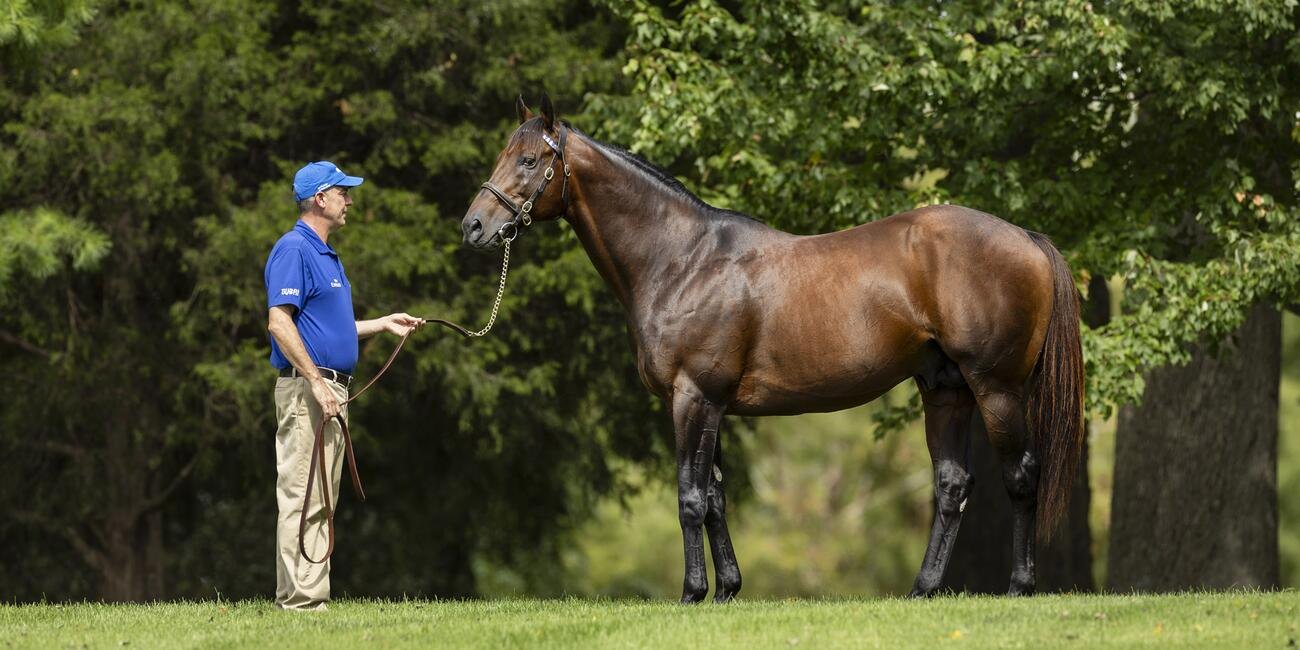
Fifty-nine yearlings sold for $31 million. The median was $400,000. Eight brought at least $1 million, and 89.4 percent of those offered eventually had reported buyers.
The distribution was good too.
Fourteen Book 1 sales produced a $737,500 median. Twenty-four sold in Book 2 at $430,000. Another 16 sold in Book 3 at $240,000.
These yearlings were conceived on an $85,000 fee. Nyquist's advertised fee is now $175,000, and our broader yearling data had his 2025 median at $300,000.
There was a time when his commercial results looked well ahead of his fee. That gap is much narrower now.
September still pushed the yearling side forward again.
Flightline and Life Is Good
Flightline and Life Is Good entered stud in 2023. Their first foals became 2-year-olds this year, so September buyers were evaluating their second yearling crops with more information than they had twelve months earlier.
Both landed in the top six by gross, but the shape of the demand was very different.
Flightline sold 52 of 64 offered for $30.9 million. His median was $467,500, eight sold for at least $1 million and he finished fourth by gross.
Eighteen Book 1 sales had a $762,500 median. Another 18 in Book 2 had a $442,500 median, while 15 sold in Book 3 at $320,000.
His fee has moved from $150,000 when these horses were conceived to $125,000 for 2026, but that reduction was not particularly visible in the prices buyers paid for the better yearlings.
Life Is Good's market had a lower ceiling and considerably more breadth.
Seventy of 74 offered eventually sold. That 94.6 percent clearance was the best of the top 10.
Only two sold for $1 million, but 50 of 53 offered in Books 1 through 3 found reported buyers at a combined $400,000 median. Then 20 of 21 offered in Books 4 through 6 sold as well, at a $177,500 median.
The later books are what changed my view of his sale. Buyers did not stop taking Life Is Goods once the select pedigrees and physicals were gone.
His fee has moved from $85,000 in 2024 to $75,000 last year and $60,000 this year. That makes the September result worth watching. The breeding market has become more cautious while the yearling market remained very willing to transact.
Both stallions have much more important tests coming on the racetrack, but they are already producing quite different commercial yearling markets.
Uncle Mo, one last time
This was the final September yearling crop for Uncle Mo.
Sixty-two sold for $23.9 million, with a $300,000 median and 87.3 percent clearance. Four brought at least $1 million.
The numbers held together as the sale moved back. Twenty Book 1 yearlings sold at a $475,000 median, 22 in Book 2 at $325,000 and 10 in Book 3 at $185,000. All six offered in Book 4 sold, along with four of five in Book 5.
That breadth seems appropriate for a stallion whose commercial appeal was never limited to one kind of horse.
Uncle Mo could give the market a dirt colt, a turf horse, a filly, a future sire or simply a good-looking yearling people wanted to own. His final crop went through September with a market that still knew exactly what to do with them.
Justify remains Justify
The Justify numbers are substantial.
Forty-nine reported sales generated $20.4 million. The median was $310,000 and three brought at least $1 million.
Then there is the 71 percent clearance rate, by far the lowest among the top 10.
This was not a late-book problem. Thirty-one were offered in Book 1 and 21 sold. Twenty-nine were offered in Book 2 and 19 sold. The six offered in Book 3 all sold.
We have seen enough of this pattern now that I am reluctant to treat it as noise.
The market for the Justifys buyers really want is strong. The market is also comfortable passing on the ones that fall outside that group, despite the stallion's international racing record and established reputation.
That was the disconnect that interested me when I wrote about him earlier, and the full September sale did little to change it.
Yaupon did something nobody else in the top 10 did
The other nine top-10 sires stood for at least $85,000 when these yearlings were conceived.
Yaupon stood for $25,000.
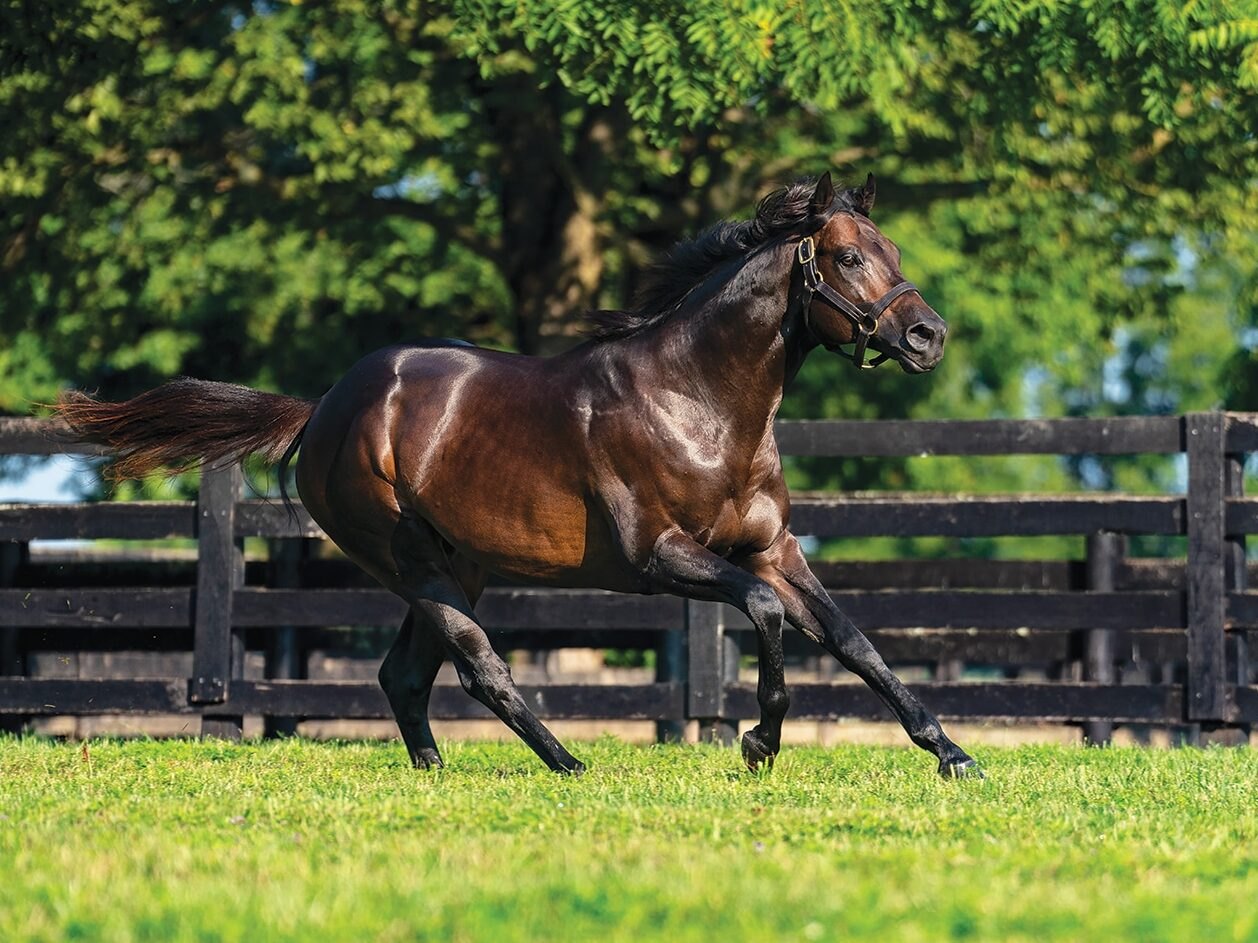
He sold 57 yearlings for $14.7 million at a $225,000 median and 87.7 percent clearance.
And he did it without a million-dollar horse.
More surprising, he did it without a reported Book 1 sale.
Thirteen Yaupons sold in Book 2 at a $310,000 median. Twenty-one sold in Book 3 at $225,000. Eighteen more sold in Book 4 at $200,000, and five sold in Book 5 at $120,000.
Books 2 through 4 alone accounted for 52 sales and more than $14 million.
That is a very different route to a top-10 gross than producing a handful of seven-figure horses at the front of the catalog.
Our broader 2025 yearling data had Yaupon at a $110,000 median. Those horses are a different population from this Keeneland group, so I would not use the comparison as a clean year-over-year appreciation statistic. It does give some sense of how quickly his commercial position has changed.
The breeding market has responded. His fee is $60,000 for 2026.
The breeders who used him for $25,000 in 2024 were ahead of that move. A surprising number of pinhookers were too.
Twenty-two completed Yaupon pinhooks in our September study returned a 2.03x median gross multiple. Only 13.6 percent sold below their public purchase price, and the group generated $3.28 million of gross appreciation before expenses.
By the time a sire is this obviously hot, the opportunity is usually starting to show up in the acquisition price. Yaupon still left room.
Farther down the fee table
For breeders working with stallions in the $15,000 to $35,000 range, another group caught my attention.
| Sire | 2024 fee | 2026 fee | KEESEP sold | Clearance | KEESEP median | Completed pinhooks | Pinhook median multiple |
|---|---|---|---|---|---|---|---|
| Yaupon | $25K | $60K | 57 | 87.7% | $225K | 22 | 2.03x |
| Vekoma | $15K | $100K | 40 | 80.0% | $145K | 9 | 1.18x |
| Girvin | $30K | $30K | 49 | 83.1% | $140K | 8 | 1.51x |
| Army Mule | $25K | $25K | 44 | 84.6% | $110K | 8 | 2.06x |
| Maxfield | $35K | $50K | 32 | 78.0% | $150K | 6 | 2.95x |
| Golden Pal | $25K | $25K | 41 | 93.2% | $100K | 6 | 1.33x |
Keeneland September figures are reported sales, including identifiable post-sale transactions. Pinhook multiples compare public purchase price to September resale price before expenses. Girvin stood the 2026 season at $30,000 and died on August 8, 2026.
I would not treat fee divided into median as an ROI calculation. The mare can represent far more capital than the season, and the table knows nothing about discounts, foal shares, board, veterinary expense, sales prep or commissions.
What the fee does tell us is where the breeder entered.
Army Mule is probably the result in this group that I had underestimated most.
He stood for $25,000 in 2024. Our broader 2025 yearling data put his median at $45,000. This September, 44 sold at a $110,000 median with 84.6 percent clearance.
His 2026 fee is still $25,000.
He also has 22 stakes winners, 9.3 percent of his starters, so the commercial move is not occurring in a vacuum.
Then there are the pinhooks. Eight completed resales produced a 2.06x median gross multiple. Only one sold below purchase price, and the group generated $913,000 in gross appreciation.
Eight horses are not enough to make broad claims, but they were enough to make me go back and look at Army Mule more carefully.
Girvin led me down a similar path.
Forty-nine yearlings sold at a $140,000 median with 83.1 percent clearance. He stood for $30,000 when they were conceived. His 2025 yearlings had a $51,000 median in our broader data, and he left 17 stakes winners.
The pinhooks were much less uniform. Eight completed trades had a 1.51x median multiple and a $72,500 median gross gain, while three sold below acquisition cost.
Girvin's story now has an unfortunate finite quality to it after his death in August at 12. These yearlings and the two younger crops behind them are the remaining commercial supply.
Vekoma
Vekoma produced one of the most interesting breeder setups in the sale.
These yearlings were conceived on a $15,000 fee.
Forty sold at Keeneland September for a $145,000 median. His advertised fee for 2026 is $100,000.
A breeder who committed in 2024 owned the foal before the market had fully priced what Vekoma was becoming.
Pinhookers entered later. Nine completed Vekoma pinhooks produced a 1.18x median gross multiple, and three sold below purchase price.
I do not think those results conflict.
By the time the pinhookers were shopping for weanlings and short yearlings, more information existed. Vekoma's runners had begun changing the way the market viewed him, and sellers were charging for some of it.
The breeder's entry point was a $15,000 season. The pinhooker was buying from an owner who increasingly knew what he had.
Yaupon is interesting because his re-rating still had farther to run. Twenty-two pinhookers found enough room to double their acquisition price at the median.
A few smaller signals
The deeper I went, the more small sire groups started throwing off interesting results. I would be careful with all of them because the pinhook samples get tiny quickly, but a few are worth remembering.
Maxfield had 32 September sales at a $150,000 median from a $35,000 2024 fee. Six completed pinhooks returned a 2.95x median multiple and about $1.5 million in gross appreciation. Six horses are nowhere near enough to call a pattern, but I want to see what the next crop does.
Golden Pal's result was less about price and more about liquidity. Forty-one of 44 offered yearlings found reported buyers, a 93.2 percent clearance rate, at a $100,000 median. His fee remains $25,000. The six completed pinhooks do not tell us much yet.
Early Voting's numbers are worth filing away for almost the opposite reason. His breeding market had cooled materially. His fee went from $20,000 in 2024 to $8,000 in 2025 before moving back to $12,500, while 17 September yearlings sold at a $125,000 median with 89.5 percent clearance.
Five completed pinhooks produced a 4.00x median gross multiple and almost $1.2 million in gross appreciation. One horse, bought for $300,000 and sold for $1.25 million, did a lot of the dollar work, though there was something underneath it: $32,000 became $130,000, $30,000 became $120,000 and $55,000 became $135,000. The fifth lost money, a $70,000 purchase that resold for $50,000.
Corniche is another one I would file away rather than explain away. His fee has fallen from $25,000 in 2024 to $15,000, yet 13 September sales produced a $150,000 median. Seven matched pinhooks returned a 2.67x median and none sold below acquisition cost.
Pappacap is useful for a different reason. Nine completed pinhooks returned a 1.76x median gross multiple, but the median gross gain was only $14,500.
That is before board, veterinary work, insurance, prep, commissions and the time value of the money. On inexpensive horses, the percentage can look terrific while the actual spread leaves very little room for ten months of expense.
None of these groups is large enough to carry a strong conclusion. They are enough to tell me where I want to look again next year.
Which moves have already been repriced?
Putting the fee history next to September makes it easier to see how quickly the breeding shed has reacted.
| Sire | 2024 fee | 2025 fee | 2026 fee |
|---|---|---|---|
| Not This Time | $150K | $175K | $250K |
| Nyquist | $85K | $175K | $175K |
| Yaupon | $25K | $25K | $60K |
| Vekoma | $15K | $35K | $100K |
| Army Mule | $25K | $20K | $25K |
| Girvin | $30K | $25K | $30K |
The 2024 season produced the yearlings sold at Keeneland September 2026. Girvin stood the 2026 season at $30,000 and died on August 8, 2026.
Vekoma is the most dramatic. The published fee moved from $15,000 to $100,000 in two seasons.
Yaupon has more than doubled.
Not This Time has gone from $150,000 to $250,000, while Nyquist jumped from $85,000 to $175,000.
Army Mule is the one that looks different to me. His fee went down and then returned to $25,000 while his September yearling median reached $110,000.
Girvin was back at the same $30,000 fee on which this crop was conceived while his September median reached $140,000.
There are plenty of reasons a farm may price a stallion where it does. Racing results, fertility, age, book size, the mares available to him and expectations about future crops all matter. One September sale cannot tell us what a stallion should cost.
I am more interested in the mismatch when one market has moved and the other has not.
Who captures the re-rating?
The more I looked at the fee history beside the pinhook results, the more I thought the timing of the investment may be as important as the sire.
A breeder makes the mating roughly two and a half years before the yearling reaches September. A pinhooker usually enters much later, after the market has had another chance to learn something about the stallion.
Vekoma is the cleanest example this year.
The breeder who used him for $15,000 in 2024 committed before his runners had completely changed the market's view of him. By September 2026, his yearlings were selling at a $145,000 median and his advertised fee had reached $100,000.
The pinhooker came into the story later. By then the seller of the weanling or short yearling knew more too.
Nine completed Vekoma pinhooks returned a 1.18x median gross multiple, and three sold below their public purchase price.
That does not make Vekoma a better breeder sire than pinhook sire. The two buyers simply entered at very different points in the re-rating.
Yaupon shows what happens when there is still another leg left in the move.
His breeders had a $25,000 starting point. Twenty-two completed pinhooks still returned a 2.03x median multiple and generated $3.28 million in gross appreciation.
The market was moving quickly, but it had not finished moving when many of those pinhookers bought.
Army Mule may be another version of it. His September yearling market moved sharply while his fee barely changed, and the small pinhook sample was strong as well.
This is the part of the sire market I find most interesting.
A stallion can be having a terrific commercial run and still offer very different economics depending on when you enter.
The breeder is trying to anticipate the re-rating. The pinhooker has to decide how much of it is already in the horse he is buying.
By the time everybody agrees a sire is hot, a lot of the opportunity may already belong to somebody else.
What September said about the sire market
Gun Runner won the headlines coming out of Book 1. Twelve million-dollar yearlings to Not This Time's six, and three of the sale's five highest prices, all in the first two sessions.
Across the other ten sessions Not This Time outgrossed him by $4.3 million. They sold within one horse of each other, 57 to 56, and finished $2.8 million apart. Gun Runner produced the higher gross and the higher ceiling. Not This Time produced the higher median, $600,000 against $525,000, from a fee $100,000 cheaper.
Not This Time took the gross title in 2025. Gun Runner took it back. That is two sires being priced for two different things, not a succession.
Life Is Good sold 70 yearlings, more than anyone else in the top 10, and cleared 94.6 percent. Nyquist sold 59 at a $400,000 median and finished third in gross from an $85,000 fee. Yaupon sold 57 and reached the top 10 without a million-dollar horse. All three cleared better than Gun Runner and Not This Time, and all three returned more against their fee: nine times his fee for Yaupon, nearly five for Nyquist, against a little over two for Gun Runner.
Keeneland September is large enough that almost every opinion about a commercial sire eventually has to become a bid, an RNA or a sale.
Methodology. Thoroughbred Intelligence analyzed the complete Keeneland September 2026 catalog at the hip level using reported results through the close of the sale. Sire statistics include identifiable post-sale transactions. Clearance is reported sales divided by horses offered, with withdrawals excluded. Keeneland reported $536.7 million in through-ring sales for 2,856 yearlings and $558.3 million including reported post-sales. Books are consecutive session pairs, with Book 1 covering sessions 1 and 2 and the sixth pair covering sessions 11 and 12. Keeneland labelled that final pair Book 6 through 2024 and renamed it Book 5B in 2025, so this analysis uses consecutive session pairs throughout to keep the years comparable.
Historical concentration figures use final Keeneland September sale totals and sire-level reported results on a comparable basis for 2024 through 2026. Post-sale reporting can continue after a sale closes, so small subsequent changes are possible.
Advertised stud fees, prior yearling-sale medians, mare books and stakes-production figures come from Thoroughbred Intelligence's stallion research. The 2024 fee corresponds to the breeding season that produced the 2026 yearlings. Prior-year yearling medians describe broader sale populations and are not presented as direct Keeneland September year-over-year comparisons. Stakes-winner counts and the stakes-winners-to-starters rate are as published by the Stallion Register.
Pinhook figures use the matched purchase-to-September transaction population developed for our full-sale pinhook analysis. Gross multiples and gross appreciation compare public purchase and resale prices before commissions, board, insurance, veterinary work, transportation, sales preparation, financing and other carrying costs. Small sire-level samples are identified as such.