
American Pharoah: Big in Japan (But What Happened in America?)
America’s first Triple Crown winner in 37 years entered stud in 2016 at $200,000. What followed was a study in the economics of breeding, the price of reputation, and the different judgments of two markets.
In this article
- From a $300,000 Buyback to a $200,000 Stud Fee
- What Buyers Paid for His Yearlings
- His Ranking Held Up as Two Cheaper Classmates Passed Him
- His American Runners Win Less Often on Dirt and Earn More on Turf
- Japan Bought In Before America Backed Off
- In Japan, He Is a Top-Third Dirt Sire With One Great Family
- His Mares Produce Better Runners by Other Stallions
- American Dirt Results Barely Predict Japanese Ones
- So What Happened in America?
- A Note From the Author
The short versionThe whole story in one paragraph
In 2015 American Pharoah became America’s first Triple Crown winner in 37 years. He went to stud in 2016 at $200,000, tied for the highest debut fee in Kentucky in 30 years, and breeders sent him 208 mares, one of the biggest books in the country. His American runners did not live up to that. At Keeneland September his colts took the deeper and lasting discount: since 2024 they have sold below the median for colts, while his fillies kept selling above the median for fillies. Not every great racehorse becomes a great stallion. American Pharoah is a good one, 14th on this year’s sire list, but not the great one his racing triumphs and initial price assumed. In Japan, where he is on lease through 2027, with his Triple Crown cachet he is a celebrity: 74 of his 102 runners there have won, and demand far exceeded his availability, with breeders asking for nearly 890 matings in his first season.
Sale results through November 3, 2026. Sire rankings through November 10, 2026. Japanese race records through November 9, 2026. The tables behind every figure are on the companion page, American Pharoah at Stud, 2016–2026.
I love American Pharoah, and so do most of the people I meet in Kentucky. Anytime I wear my Coolmore American Pharoah jacket in Versailles or Lexington, someone inevitably comes up to me with an American Pharoah story, or just to tell me how much they love him. It has happened at a basketball game in Austin, Texas, and at the airport in Portland, Oregon. My other stallion swag never gets that reaction.
Most trainers and bloodstock types are a different audience. Their answer is a hard no. No thank you, not interested. I didn’t get it. He has ranked in the top 20 of the standard sire rankings by progeny earnings every year since 2021, he has sired Grade 1 winners on four continents, and in Japan, where he stood the 2026 season, 74 of his 102 runners have won at least one race. So what happened in America?
We went back through every American Pharoah yearling offered at Keeneland September, eight years of sire rankings split by surface and by country, and every start his runners have made in Japan, race by race, and set him against 36 other American sires whose runners race there. The question changed as we worked. What did each market expect from him, what did it get, and why did the two answers come out so far apart?
From a $300,000 Buyback to a $200,000 Stud Fee
The first time the market had a chance to price American Pharoah, it said no. Taylor Made consigned him to the Fasig-Tipton Saratoga yearling sale in August 2013, a colt by Pioneerof the Nile out of Littleprincessemma, bred by Ahmed Zayat. The bidding stopped short of what his breeder wanted, and Zayat’s agent bought him back at the posted minimum of $300,000.
He went to Bob Baffert instead. He finished fifth in his debut at Del Mar in August 2014, won two Grade 1 races, the Del Mar Futurity and the FrontRunner, and was named champion 2-year-old without running in the Breeders’ Cup. At three he won the Grade 2 Rebel and the Grade 1 Arkansas Derby, then the Kentucky Derby by a length and the Preakness by seven on a sloppy track.
His stud career was sold before the Triple Crown was won. On May 20, 2015, between the Preakness and the Belmont, Zayat announced that he had sold the breeding rights to Ashford Stud, Coolmore’s Kentucky operation, and kept the racing rights. The terms were not disclosed.
Coolmore bought him with two legs of the Triple Crown won. Then he won the Belmont by five and a half lengths, the first Triple Crown since Affirmed in 1978. He won the Haskell, and his only defeat after his debut came in the Travers, by three-quarters of a length to Keen Ice. He finished in the Breeders’ Cup Classic at Keeneland, his first race against older horses, and won it by six and a half lengths in a track-record 2:00.07. Eleven starts, nine wins, $8,650,300, Horse of the Year.
Table 1 · The racehorse
Eleven starts, nine wins, eight of them Grade 1 races
Show the race record
| Date | Race | Track | Distance | Surface | Finish | Margin (lengths) |
|---|---|---|---|---|---|---|
| Aug. 9, 2014 | Maiden special weight | Del Mar | 6½ furlongs | Synthetic | 5th | beaten 9¼ |
| Sept. 3, 2014 | Del Mar Futurity (G1) | Del Mar | 7 furlongs | Synthetic | 1st | 4¾ |
| Sept. 27, 2014 | FrontRunner (G1) | Santa Anita | 1 1/16 mi. | Dirt | 1st | 3¼ |
| March 14, 2015 | Rebel (G2) | Oaklawn | 1 1/16 mi. | Dirt | 1st | 6¼ |
| April 11, 2015 | Arkansas Derby (G1) | Oaklawn | 1 1/8 mi. | Dirt | 1st | 8 |
| May 2, 2015 | Kentucky Derby (G1) | Churchill Downs | 1 1/4 mi. | Dirt | 1st | 1 |
| May 16, 2015 | Preakness (G1) | Pimlico | 1 3/16 mi. | Dirt, sloppy | 1st | 7 |
| June 6, 2015 | Belmont (G1) | Belmont Park | 1 1/2 mi. | Dirt | 1st | 5½ |
| Aug. 2, 2015 | Haskell Invitational (G1) | Monmouth Park | 1 1/8 mi. | Dirt | 1st | 2¼ |
| Aug. 29, 2015 | Travers (G1) | Saratoga | 1 1/4 mi. | Dirt | 2nd | beaten ¾ |
| Oct. 31, 2015 | Breeders’ Cup Classic (G1) | Keeneland | 1 1/4 mi. | Dirt | 1st | 6½ |

He retired to Ashford for 2016 at an advertised debut fee of $200,000. Only Tapit, at $300,000, stood for more in America that year, and War Front stood for the same $200,000. The highest advertised freshman debut stud fee in Kentucky over the past 30 years (1996–2026) is $200,000, a record shared by three stallions: Ghostzapper, American Pharoah, and Flightline. Talk about high expectations!
Table 2 · Priced as a sire before he had a foal
Three Kentucky stallions have debuted at $200,000 since 1996; in today’s dollars Ghostzapper’s fee was the highest
| Stallion | First season | Farm | Advertised fee | In October 2026 dollars |
|---|---|---|---|---|
| Ghostzapper | 2006 | Adena Springs | $200,000 | $335,000 |
| Fusaichi Pegasus | 2001 | Ashford | $150,000 | $286,000 |
| American Pharoah | 2016 | Ashford | $200,000 | $281,000 |
| Point Given | 2002 | Three Chimneys | $125,000 | $235,000 |
| Flightline | 2023 | Lane’s End | $200,000 | $222,000 |
| Justify | 2019 | Ashford | $150,000 | $198,000 |
He was the horse Kentucky’s commercial market is built around: a dirt colt who won the Belmont at a mile and a half in June and beat older horses at a mile and a quarter in October. The yearling the market would not buy for $300,000 retired to stand for $200,000 a cover.
What Buyers Paid for His Yearlings
Breeders filled his book anyway. He covered 208 mares in 2016, the largest book of any first-season sire and the third-largest in North America, behind Uncle Mo’s 253 and Into Mischief’s 218. Coolmore later offered some breeders two approved mares for a combined $200,000, the Daily Racing Form reported, so the advertised fee was not what every mare cost.
Ashford stopped advertising a fee for 2017 and 2018. Those are the seasons when a young stallion has no runners to show and breeders tend to wait for them.
His first yearlings reached Keeneland September in 2018, and the 50 that sold in the ring brought a $305,000 median, more than six times the $50,000 median for all yearlings sold that year. Ashford announced his 2019 fee at $110,000 as that sale closed, then listed it as private again. A year later Whisper Hill paid $8,200,000 for his filly out of Leslie’s Lady, the dam of Into Mischief and Beholder.
Then his first crop raced, and it was good. He finished 2019 as North America’s leading freshman sire by progeny earnings, and Ashford raised his advertised fee to $175,000 for 2020. That was the high-water mark of the market’s belief in him.
Ashford cut the fee to $100,000 for 2021, announcing it in October 2020, the same month Harvey’s Lil Goil gave him his first Grade 1 winner, on turf in the Queen Elizabeth II at Keeneland. At Keeneland September in 2021, the first sale after buyers had watched two of his crops race, his yearlings sold at 2.31 times the sale median, down from between 4.79 and 6.10 times in his first three sales. Part of that drop is the sale median nearly doubling after Covid, from $37,000 to $65,000, but his own median also fell, from $200,000 to $150,000.
The fee kept falling: $80,000 for 2022, $60,000 for 2023, $50,000 for 2024 and $45,000 for 2025, his last season in Kentucky before Japan. The sale ring followed. In 2024 his median fell to $70,000, level with the sale’s, for yearlings conceived at $80,000.
Figure 1 · Two steps down
His colts fell from four times the colt median to half of it; his fillies fell from seven times the filly median to between one and two times it
Show the data
| Sale | Conceived, fee | His sold | His median | Sale median | Multiple | His colts sold | His colt median | All colts | Colt multiple | His fillies sold | His filly median | All fillies | Filly multiple |
|---|---|---|---|---|---|---|---|---|---|---|---|---|---|
| 2018 | 2016, $200,000 | 50 | $305,000 | $50,000 | 6.10 | 31 | $275,000 | $60,000 | 4.58 | 19 | $310,000 | $43,000 | 7.21 |
| 2019 | 2017, Private | 62 | $225,000 | $47,000 | 4.79 | 29 | $200,000 | $55,000 | 3.64 | 33 | $250,000 | $38,000 | 6.58 |
| 2020 | 2018, Private | 31 | $200,000 | $37,000 | 5.41 | 14 | $190,000 | $45,000 | 4.22 | 17 | $200,000 | $30,000 | 6.67 |
| 2021 | 2019, $110,000 announced, then private | 40 | $150,000 | $65,000 | 2.31 | 18 | $150,000 | $70,000 | 2.14 | 22 | $150,000 | $55,000 | 2.73 |
| 2022 | 2020, $175,000 advertised | 47 | $180,000 | $70,000 | 2.57 | 26 | $150,000 | $75,000 | 2.00 | 21 | $200,000 | $60,000 | 3.33 |
| 2023 | 2021, $100,000 | 41 | $150,000 | $67,000 | 2.24 | 18 | $187,500 | $75,000 | 2.50 | 23 | $150,000 | $60,000 | 2.50 |
| 2024 | 2022, $80,000 | 31 | $70,000 | $70,000 | 1.00 | 16 | $65,000 | $73,500 | 0.88 | 15 | $75,000 | $60,000 | 1.25 |
| 2025 | 2023, $60,000 | 23 | $85,000 | $80,000 | 1.06 | 12 | $50,000 | $90,000 | 0.56 | 11 | $140,000 | $70,000 | 2.00 |
| 2026 | 2024, $50,000 | 19 | $65,000 | $85,000 | 0.76 | 8 | $47,500 | $95,000 | 0.50 | 11 | $100,000 | $75,000 | 1.33 |
His colts took the lasting discount. They sold at about four times the colt median in his first three sales and have sold below it every year since 2024, at half of it this September. His fillies fell too, from about seven times the filly median to between one and two times it, but they never sold below it.
This September was the test of the cheaper fee. The crop was conceived in 2024 at $50,000, and none of the 44 catalogued was placed in Book 1. Its $65,000 median was 0.76 times the sale’s $85,000, the weakest showing relative to the market of any crop he has sold. His colts sold at a $47,500 median, against $95,000 for all colts sold. A commercial breeder’s break-even is often figured at twice the fee plus $20,000, which is $120,000 for this crop. One Kentucky crop remains: the foals conceived at $45,000 in 2025 sell as yearlings next September.
At the top of the market the split is complete. Since 2021, eight American Pharoahs have sold for $1,000,000 or more at the North American auctions we track, and all eight were fillies or mares. The last seven-figure colt was the $1,250,000 colt out of Swingit at Fasig-Tipton’s Selected Yearlings Showcase in September 2020.
Table 3 · Seven figures, all female
Every American Pharoah sold for $1,000,000 or more since 2021 was a filly or mare
| Horse | Sale | Year | Price |
|---|---|---|---|
| Yearling filly out of Letgomyecho | Keeneland September | 2021 | $1,400,000 |
| 2-year-old filly out of Just Parker | OBS March | 2022 | $1,000,000 |
| Fabulous | Fasig-Tipton November | 2022 | $1,500,000 |
| Flattermewithroses | Fasig-Tipton November | 2023 | $2,000,000 |
| Yearling filly out of Just Louise | Keeneland September | 2024 | $1,350,000 |
| Lonelily | Fasig-Tipton November | 2024 | $1,200,000 |
| Kathynmarissa | Fasig-Tipton November | 2026 | $3,200,000 |
| Hip 119, weanling filly out of Lady Irene | Keeneland November | 2026 | $1,000,000 |
The latest sold on the night of November 3 at Keeneland November. Hip 119 is a filly from his most recent crop conceived in Kentucky before he left for Japan, conceived at $45,000, out of Lady Irene, a daughter of Leslie’s Lady. Clarkland Farm consigned her, as it consigned the $8,200,000 Leslie’s Lady filly in 2019. Glen Hill Farm paid $1,000,000, 22.2 times the fee. The top filly prices come from families like that one, and an American Pharoah filly from a strong family carries value as a broodmare whatever she does on the track. Buyers kept paying for that. They stopped paying a premium for his colts, whose value rests on what they do on dirt.
His Ranking Held Up as Two Cheaper Classmates Passed Him
By the measure most people cite, he held up. He led his freshman class in 2019 and has ranked in the top 20 of the standard sire rankings by progeny earnings every year since 2021. In 2023 he was sixth. Buyers who watched his yearlings fall below the sale median kept seeing his name near the top of the list, and the gap between those two pictures is a large part of why the industry argues about him.
Volume helped put him there. He sent out between 258 and 317 runners a year from 2021 through 2026, from books that ran to more than 200 mares, about twice as many as the median sire among the 150 on the list.
So did money won outside North America. The standard rankings count Northern Hemisphere runners wherever they race, crediting Japanese purses at 84 percent. Every year from 2019 through 2026, between 16.2 and 33.4 percent of his credited earnings came from races outside North America.
Figure 2 · Where the ranking came from
Roughly a sixth to a third of his money every year came from races outside North America
Show the data
| Year | Standard-list rank | Runners | Earnings | North American rank | Runners | Earnings | Elsewhere | Share elsewhere | Extra runners |
|---|---|---|---|---|---|---|---|---|---|
| 2019 | 122 | 72 | $2,703,916 | 139 | 53 | $2,267,229 | $436,687 | 16.2% | 19 |
| 2020 | 28 | 169 | $5,814,783 | 52 | 127 | $3,874,300 | $1,940,483 | 33.4% | 42 |
| 2021 | 16 | 258 | $8,770,074 | 23 | 198 | $7,344,927 | $1,425,147 | 16.3% | 60 |
| 2022 | 11 | 299 | $10,902,974 | 19 | 225 | $8,461,551 | $2,441,423 | 22.4% | 74 |
| 2023 | 6 | 297 | $13,427,390 | 16 | 213 | $9,543,816 | $3,883,574 | 28.9% | 84 |
| 2024 | 15 | 317 | $11,675,675 | 22 | 211 | $9,108,576 | $2,567,099 | 22.0% | 106 |
| 2025 | 16 | 297 | $11,974,412 | 27 | 200 | $8,216,926 | $3,757,486 | 31.4% | 97 |
| 2026 (to Nov. 9) | 14 | 260 | $11,827,250 | 19 | 177 | $9,087,757 | $2,739,493 | 23.2% | 83 |
His sixth place in 2023 rested on one race. Cafe Pharoah, a Japan-based son, ran third in the Saudi Cup in Riyadh that February and collected $2,000,000, about half of everything American Pharoah’s runners earned outside North America that year. Without that check he would have ranked tenth. Count only races run in North America and he was 16th in 2023, and between 19th and 27th in every other year since 2021.
Strip out volume and he looks like a solid sire. Counting North American racing alone, his earnings per runner ranked in the top third of sires with at least 150 runners in five of the six years from 2021 through 2026. The standard list understates him here, because his runners abroad earn less per head at its exchange rates. But Into Mischief’s, Curlin’s and Gun Runner’s runners never earned less than $55,990 each in North America in any of those years, and American Pharoah’s never earned more than $51,343. Buyers paid for a stallion in the first group and got one in the second.
The stallions who entered stud with him had their first foals meet the same market at the same time, though each covered different mares. Kentucky’s class of 2016 stood for between $20,000 and $40,000. American Pharoah stood for $200,000, five times the next highest.
Table 4 · Kentucky’s class of 2016, then and now
He stood for five times the next-highest fee; two classmates who started at $25,000 now rank above him
| Stallion | 2016 farm | 2016 fee | 2016 mares | 2026 location | 2026 fee | 2026 mares | 2026 sire rank by earnings |
|---|---|---|---|---|---|---|---|
| American Pharoah | Ashford | $200,000 | 208 | Shizunai, Japan | ¥4,000,000 ($25,300) | 218 | 14 |
| Constitution | WinStar | $25,000 | 172 | WinStar, Ky. | $110,000 | 184 | 7 |
| Liam’s Map | Lane’s End | $25,000 | 148 | Lane’s End, Ky. | $50,000 | 169 | 9 |
| Tonalist | Lane’s End | $30,000 | 138 | Lane’s End, Ky. | $10,000 | 7 | 88 |
| Honor Code | Lane’s End | $40,000 | 144 | Yushun, Japan | ¥1,500,000 ($9,500) | 102 | 150 |
| Palace Malice | Three Chimneys | $20,000 | 158 | Darley Japan | ¥3,500,000 ($22,100) | 246 | 121 |
| Carpe Diem | WinStar | $25,000 | 163 | LACER, La. | $3,500 | 57 | – |
Constitution is the comparison that stings. WinStar cut his fee to $15,000 for 2019, when he covered 85 mares. Then his first runners arrived. His fee passed American Pharoah’s in 2022, $85,000 to $80,000, and has been $110,000 since 2023, a fee WinStar is holding for 2027.
Count only North American races, and Constitution led the sires of his crop age in five of the six years from 2019 through 2024; American Pharoah led once, with his first crop. In 2024 and 2025 Constitution ranked third and fifth among all sires on North American racing, and American Pharoah 22nd and 27th. On this year’s standard list Constitution is seventh, and his son Tiz the Law, who stands at Ashford, is tenth. His money is also spread wider. His top earner this year accounts for 5.6 percent of his total; Kathynmarissa accounts for 16.7 percent of American Pharoah’s.
Liam’s Map took longer and got there. Lane’s End has raised him from $20,000 for 2019 to $80,000 for 2027; American Pharoah’s last Kentucky fee was $45,000. On North American racing Liam’s Map passed him in 2025 and is eighth this year, against American Pharoah’s 19th. On the standard list he is ninth, American Pharoah 14th.
The rest of the class went three ways. Tonalist’s runners earned well, and Country Grammer won the 2022 Dubai World Cup for him, but breeders left him anyway: 138 mares in 2016, 7 this year, and a $5,000 fee for 2027. Carpe Diem stands in Louisiana for $3,500. Palace Malice and Honor Code went to Japan in 2024, Palace Malice from a book of six mares in Kentucky in 2023 to 262 in his first Japanese season. American Pharoah followed them in 2026.
His American Runners Win Less Often on Dirt and Earn More on Turf
The rankings can also be split by surface. We compared him with the 150 leading sires on each surface, North American races only, every year from 2019 through 2026.
Figure 3 · One sire, two surfaces
Bottom fifth of leading dirt sires by share of winners every year; top quarter of leading turf sires by earnings per runner in five of seven
Show the data
| Year | Dirt rank | Dirt runners | Winners | Share who won | Median sire | Percentile | Turf rank | Turf runners | Turf earnings | Per runner | Median sire | Percentile |
|---|---|---|---|---|---|---|---|---|---|---|---|---|
| 2020 | 84 | 82 | 22 | 26.8% | 43.1% | 0 | 17 | 94 | $1,953,562 | $20,783 | $12,800 | 84 |
| 2021 | 47 | 133 | 47 | 35.3% | 47.5% | 6 | 10 | 142 | $3,171,919 | $22,337 | $17,102 | 74 |
| 2022 | 31 | 149 | 61 | 40.9% | 47.7% | 15 | 19 | 137 | $2,551,738 | $18,626 | $17,141 | 55 |
| 2023 | 43 | 149 | 55 | 36.9% | 47.6% | 9 | 9 | 137 | $4,235,015 | $30,913 | $16,826 | 89 |
| 2024 | 64 | 131 | 55 | 42.0% | 47.3% | 18 | 9 | 142 | $4,895,573 | $34,476 | $17,296 | 88 |
| 2025 | 48 | 116 | 48 | 41.4% | 47.6% | 17 | 19 | 130 | $3,339,696 | $25,690 | $18,592 | 77 |
| 2026 (to Nov. 9) | 67 | 99 | 38 | 38.4% | 47.0% | 13 | 5 | 116 | $5,683,402 | $48,995 | $18,923 | 96 |
On dirt his runners win less often than most. Every year from 2020 through 2026, the share of his dirt runners who won a dirt race ranked in the bottom fifth of the 150 leading dirt sires. Even in his best year, 2024, it was 42.0 percent, against 47.3 percent for the median sire on the list. Constitution ranked between 5th and 17th among dirt sires by earnings in every one of those years.
On turf his runners win at an ordinary rate and earn well. He has ranked between 5th and 19th among turf sires by earnings every year since 2020, and he is 5th this year. His earnings per turf runner sat in the top quarter of the 150 in five of the seven years.
His best horses lean the same way. The Japan Bloodhorse Breeders’ Association’s stallion notice of October 2025 names nine Grade 1 winners by him. Kathynmarissa made it ten in July, in the Diana at Saratoga, and added the Breeders’ Cup Filly & Mare Turf on October 31. Seven of the ten won on turf. Five are fillies. Riff Rocket won the Australian Derby over 2,400 meters on turf, so stamina is not the issue. Of the three that won on dirt, Cafe Pharoah won his in Japan, As Time Goes By is a filly, and American Theorem’s Grade 1 was the Bing Crosby, six furlongs at Del Mar. None of the ten is an American colt who won a Grade 1 on dirt beyond a sprint. Both of his Breeders’ Cup winners, Four Wheel Drive in the 2019 Juvenile Turf Sprint and Kathynmarissa, won on turf.
Kentucky’s commercial market, and the trainers who buy in it, pay most for a dirt colt with classic distance. American Pharoah was that horse, and buyers paid $200,000 expecting him to sire it. On American dirt his runners win less often than those of at least four in five of the leading dirt sires, and his best American runners have been turf horses and fillies.
Japan Bought In Before America Backed Off
Japan’s biggest breeders bought into American Pharoah early, before his first runner had started.
At Keeneland November in 2017, Shadai Farm paid $950,000 for Top Decile, in foal to him. At Fasig-Tipton November in 2020, Katsumi Yoshida paid $1,950,000 for Paris Bikini and $2,200,000 for Miss Besilu, and Shadai paid $1,300,000 for Competitionofideas. All three produced American Pharoah foals in Japan in 2022. At Keeneland November in 2021, Japanese buyers took five more mares in foal to him.
Mares like these produced most of his 2022 crop in Japan. Of its 32 runners there, 21 were foaled in Japan from mares shipped over in foal. They were conceived in the 2021 breeding season, the same year his Keeneland multiple fell from 5.41 to 2.31.
They kept buying his daughters too. Kathynmarissa sold for $200,000 out of Book 3 at Keeneland in 2022. Four years later, two days after her Breeders’ Cup win, Katsumi Yoshida of Northern Farm paid $3,200,000 for her at Fasig-Tipton. The Breeders’ Cup was the biggest factor, but Shingo Hashimoto, who bid for Yoshida, told BloodHorse the decision was also shaped by American Pharoah’s influence as a broodmare sire and by the fact that he is standing in Japan. She is going to Japan, and Hashimoto said Equinox, the two-time Japanese Horse of the Year, who stands for ¥25,000,000, about $158,000, is among the stallions being considered for her first mating. On November 3 Haruya Yoshida bought Carnaby Street, an American Pharoah mare in foal to Twirling Candy, for $350,000 at Keeneland. Twenty-one of his daughters who raced in Japan are already in the breeding shed there.
Japan wanted the stallion himself. Japanese parties had wanted to buy him for a number of years, the Daily Racing Form reported, before a compromise let him stand there and then come home. In October 2025 the Japan Bloodhorse Breeders’ Association announced it would bring him to its Shizunai Stallion Station in Hokkaido for the 2026 season, on a one-year lease. In June the lease was extended through 2027, and his return to Ashford is planned for the summer of 2027. Ashford’s Dermot Ryan said he “has proven extremely popular with breeders in Japan.”
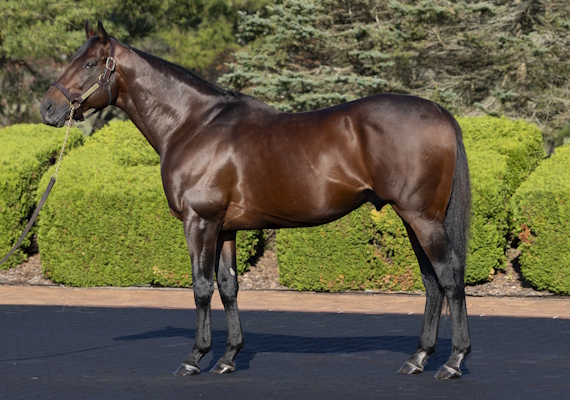
The JBBA’s own paperwork shows how popular. His fee is ¥4,000,000, about $25,300, tax included, payable once the mare is confirmed in foal, and it stays at ¥4,000,000 for 2027. At current exchange rates that is a little over half the $45,000 he stood for in his last Kentucky season. Twenty-one stallions in Japan stood for more in 2026, led by Kitasan Black and Equinox at ¥25,000,000. He covered 218 mares, by the JBBA’s count, the fourth-largest book in Japan and one behind Equinox. Seven stallions passed 200, and the largest book, Palace Malice’s 246, came at ¥3,500,000, about $22,100. The Japan Racing Horse Association’s review of the season, published October 25, called him in effect the most popular stallion in Japan this year and said requests to breed to him had been reported at close to 890 mares.
The JBBA had to ration him. For 2026 it took bookings by telephone two days ahead, capped him at three covers a day, reserved the right to refuse mares aged 19 or older, mares barren two years running and mares on their foal heat, and said that when he was oversubscribed it would choose mares on their pedigree, age and produce record. Shigeki Yusa, the station’s manager at the time, told Sponichi in June that so many breeders had applied that the station still had not been able to accommodate them all, and that their requests were why the stay was extended. “Two hundred eighteen is quite a number,” he said. His foals, he added, seem to suit Japanese racing. For 2027 the JBBA kept the fee and the cap and added a rule that owners holding the fewest mares already in foal to him go first. Two of his sons stand in Japan as well: Cafe Pharoah, who covered 168 mares in 2026 at ¥2,000,000, about $12,600, and Four Wheel Drive, who covered 134 at ¥1,500,000, about $9,500.
In Japan, He Is a Top-Third Dirt Sire With One Great Family
Most of his runners in Japan win. When Ashford announced the extension in June, it counted 70 winners from 93 runners there. Through November 9 it is 74 winners from 102 runners, 72.5 percent. Six of them have won black-type races, 15 between them, led by Cafe Pharoah, a two-time winner of the February Stakes, a Group 1, and his brother Luxor Cafe, a two-time Group 3 winner.
Japanese trainers race his horses on dirt. We pulled every start his runners have made in Japan, 1,273 through November 9. Of those, 1,117 were on dirt, and 221 of the 237 wins and 14 of the 15 stakes wins came on dirt. Two of his runners have won at the top level there, four times between them, all on dirt: Cafe Pharoah in the February Stakes in 2021 and 2022 and the Mile Championship Nambu Hai in 2022, and Danon Pharaoh in the 2020 Japan Dirt Derby. The one turf stakes win was Reframe’s, in the Paradise Stakes at Tokyo in 2022.
Selection could explain some of that. Japanese buyers pick American horses they expect to suit Japanese dirt. The 41 runners foaled in Japan from mares shipped over in foal give us a partial check, because their buyers bought the mating before the foal existed and nobody picked the horse on its looks or its breeze. They win at almost exactly the same rate: 29 of the 41, against 41 of the 57 bought as American-foaled horses. The other four were foaled in Australia and Great Britain.
A good share of the winning came on the regional NAR circuit, 135 of his 221 dirt wins, and the betting market priced those runners almost exactly right.
A useful comparison for an American sire in Japan is other American sires. We set him against 36 American-based sires whose runners race there, using the JRA’s records from 2019 through 2026. Both sides of the comparison include runners foaled in Japan from imported mares.
Figure 4 · Top third on rank
Seventh of 23 American sires on JRA dirt, a point above the other 36 combined
Show the data
| Rank | Sire | Dirt wins | Dirt starts | Dirt win rate | Turf wins | Turf starts | Turf win rate | JRA graded wins | Career JRA runners |
|---|---|---|---|---|---|---|---|---|---|
| 1 | Into Mischief | 73 | 395 | 18.5% | 8 | 83 | 9.6% | 0 | 48 |
| 2 | Nyquist | 11 | 63 | 17.5% | 0 | 8 | 0.0% | 0 | 12 |
| 3 | Union Rags | 11 | 63 | 17.5% | 0 | 11 | 0.0% | 0 | 12 |
| 4 | Frosted | 13 | 77 | 16.9% | 14 | 67 | 20.9% | 2 | 15 |
| 5 | Arrogate | 28 | 172 | 16.3% | 2 | 15 | 13.3% | 0 | 18 |
| 6 | Malibu Moon | 16 | 101 | 15.8% | 0 | 13 | 0.0% | 0 | 29 |
| 7 | American Pharoah | 86 | 611 | 14.1% | 16 | 150 | 10.7% | 6 | 99 |
| 8 | Gun Runner | 27 | 202 | 13.4% | 2 | 39 | 5.1% | 0 | 25 |
| 9 | Justify | 36 | 275 | 13.1% | 1 | 46 | 2.2% | 0 | 44 |
| 10 | Uncle Mo | 23 | 181 | 12.7% | 6 | 42 | 14.3% | 0 | 35 |
| 11 | Liam’s Map | 13 | 102 | 12.7% | 1 | 25 | 4.0% | 0 | 15 |
| 12 | Tapit | 33 | 274 | 12.0% | 4 | 68 | 5.9% | 0 | 48 |
| 13 | Speightstown | 34 | 288 | 11.8% | 12 | 99 | 12.1% | 2 | 53 |
| 14 | Pioneerof the Nile | 15 | 130 | 11.5% | 0 | 12 | 0.0% | 0 | 17 |
| 15 | Distorted Humor | 11 | 98 | 11.2% | 0 | 4 | 0.0% | 0 | 37 |
| 16 | Quality Road | 15 | 135 | 11.1% | 0 | 13 | 0.0% | 0 | 18 |
| 17 | Kitten’s Joy | 7 | 64 | 10.9% | 9 | 85 | 10.6% | 2 | 31 |
| 18 | Constitution | 9 | 86 | 10.5% | 3 | 25 | 12.0% | 0 | 12 |
| 19 | War Front | 8 | 76 | 10.5% | 7 | 57 | 12.3% | 0 | 18 |
| 20 | Curlin | 16 | 159 | 10.1% | 0 | 21 | 0.0% | 0 | 29 |
| 21 | Bernardini | 7 | 70 | 10.0% | 2 | 17 | 11.8% | 0 | 38 |
| 22 | Practical Joke | 11 | 123 | 8.9% | 5 | 60 | 8.3% | 0 | 15 |
| 23 | Medaglia d’Oro | 6 | 87 | 6.9% | 4 | 71 | 5.6% | 0 | 45 |
| The 36 other American sires | 478 | 3,660 | 13.1% | 112 | 1,087 | 10.3% | 10 |
His runners won 14.1 percent of their JRA dirt starts, against 13.1 percent for the 36 other American sires combined. That ranks seventh among the 23 American sires with at least 60 JRA dirt starts, in the top third. Into Mischief leads at 18.5 percent.
Against the betting market he did a little better than expected, 86 JRA dirt wins against 73.9 implied by the odds, though one 252-to-1 winner accounts for most of the edge.
What sets him apart from the other American sires is scale and one family at the top. He has had 99 runners in JRA races, nearly twice as many as the next American sire. His runners have won six graded stakes at the JRA, against ten for the other 36 sires combined, and two brothers won all six.
Cafe Pharoah, by American Pharoah out of Mary’s Follies, cost $475,000 at OBS March in 2019. He won all four of his starts over the Tokyo dirt mile, including the February Stakes twice, and finished 17th and 12th when Japan tried him on turf over the same mile in the Yasuda Kinen. His full brother Luxor Cafe won the Musashino Stakes in 2025 and the Elm Stakes this August. Between them they have earned 24.0 percent of all the prize money won by American Pharoah’s runners in Japan.
Away from Japan the brothers have not won. Cafe Pharoah ran third in the 2023 Saudi Cup and 12th in the Dubai World Cup. Luxor Cafe ran 12th in the 2025 Kentucky Derby and fifth in this year’s Saudi Cup. Two of the best dirt horses in Japan are 0 for 4 on dirt outside it, and the one placing among the four is the check that lifted their sire to sixth on the 2023 rankings.
The prize money in Japan also flatters the numbers beneath the brothers. June Blair has earned ¥156,810,000, about $991,000, without winning a stakes race. The median runner in our file has earned ¥7,020,000, about $44,400.
His Mares Produce Better Runners by Other Stallions
If American Pharoah’s runners do a little better than other American sires’ in Japan and much worse on American dirt, the question is what he contributes on his own.
The industry’s measure of that sets two indexes side by side. The Average-Earnings Index scores his runners’ earnings against all runners; the Comparable Index scores what his mares produced by other stallions. Most sires fall a little short of their mares. American Pharoah falls far short: an AEI of 1.38 against his mares’ 2.09. Among the 118 of the 150 leading sires with at least six crops racing, that is the largest gap, tied with his classmate Honor Code’s; the only two larger gaps on the list belong to sires with two crops. His mares produce better runners by other stallions than by him. Liam’s Map’s runners earn at the same rate as his out of weaker mares, and Constitution and Tonalist have beaten their mares. The index measures the gap; it does not say why.
His mares and his results declined together. In November 2020 his runners’ AEI was 1.71 and his mares’ CI 2.98; by 2025 they were 1.39 and 2.13, lifetime figures that by then took in younger crops from thinner books. The share of his runners winning black-type races fell from between 5.6 and 5.9 percent in 2019 through 2021 to between 2.7 and 3.8 percent in 2022 through 2025.
The crops tell the same story one at a time. On North American racing his best crop by far was conceived in 2020, the season Ashford advertised his fee at $175,000 after he led the freshman list. As 3-year-olds in 2024, 7 of its 56 runners won black-type races, and they earned $72,976 per runner, well above any of his other crops. His first three crops, conceived at $200,000 and then at private fees, earned the least per runner as 3-year-olds. The mares and the stallion both shaped that record, and these figures cannot say in what proportion.
In Japan the mare shows up in the surface as well. We sorted his JRA runners by their dams’ sires. Out of mares by dirt or dual-surface sires, his runners won about twice what field size alone would predict on dirt and slightly below it on turf. Out of mares by turf sires, a group of only 16 horses, it ran the other way. And the JBBA has now put a filter on his Japanese books: when he is oversubscribed, it picks mares on produce record. His first Japanese-conceived crop will come from mares that were screened.
Outside Japan the pattern does not hold. Several of his turf Group 1 winners are out of mares by dirt sires: Harvey’s Lil Goil’s dam is by Tapit, Goldrush Guru’s by Medaglia d’Oro, Kathynmarissa’s by Milt’s Overture. His elite runners in America, Europe and Australia lean toward turf whatever the mare.
American Dirt Results Barely Predict Japanese Ones
The two dirts are different surfaces. Three Japanese researchers writing in the Journal of Equine Science in 2016 described a Japanese dirt course as a cushion of fine river sand seven to eight centimeters deep over a hard base, different enough that they write it “might be preferable to refer to it as a sand course rather than a dirt course.” The New York Racing Association’s dirt, by comparison, is a 10-to-12-centimeter cushion of sandy loam over a base mixed with clay, silt and sand.
If the surfaces ask different things of a horse, a sire’s American dirt record should say little about his Japanese one. We checked across the 23 American sires in the Japan comparison.
Figure 5 · American dirt does not predict Japanese sand
A sire’s record on American dirt says little about his record on Japanese dirt
Show the data
| Sire | Years on the dirt list | Dirt runner-seasons | Share who won | Median dirt percentile | Turf share of NA money | JRA dirt win rate |
|---|---|---|---|---|---|---|
| War Front (excluded: one dirt-list year) | 1 | 45 | 26.7% | 1 | 88.8% | 10.5% |
| Kitten’s Joy | 4 | 543 | 32.4% | 1 | 83.0% | 10.9% |
| American Pharoah | 7 | 859 | 38.0% | 13 | 51.9% | 14.1% |
| Justify | 5 | 438 | 34.9% | 3 | 46.1% | 13.1% |
| Medaglia d’Oro | 8 | 849 | 39.6% | 19 | 40.8% | 6.9% |
| Pioneerof the Nile | 5 | 621 | 41.9% | 21 | 39.5% | 11.5% |
| Liam’s Map | 7 | 1,092 | 41.6% | 26 | 37.6% | 12.7% |
| Uncle Mo | 8 | 1,600 | 43.4% | 30 | 34.2% | 12.7% |
| Constitution | 8 | 1,347 | 41.6% | 20 | 31.9% | 10.5% |
| Quality Road | 8 | 1,290 | 44.0% | 24 | 31.0% | 11.1% |
| Speightstown | 8 | 1,029 | 50.6% | 75 | 29.0% | 11.8% |
| Distorted Humor | 7 | 777 | 45.4% | 53 | 28.5% | 11.2% |
| Nyquist | 7 | 1,002 | 41.2% | 15 | 24.6% | 17.5% |
| Malibu Moon | 7 | 1,271 | 47.7% | 53 | 22.5% | 15.8% |
| Frosted | 6 | 1,013 | 44.9% | 28 | 21.6% | 16.9% |
| Tapit | 8 | 1,242 | 39.6% | 11 | 20.8% | 12.0% |
| Into Mischief | 8 | 2,671 | 45.8% | 37 | 18.7% | 18.5% |
| Bernardini | 7 | 1,003 | 43.0% | 22 | 16.5% | 10.0% |
| Practical Joke | 6 | 1,276 | 48.2% | 39 | 13.8% | 8.9% |
| Curlin | 8 | 1,546 | 46.7% | 45 | 11.6% | 10.1% |
| Union Rags | 8 | 1,501 | 44.2% | 27 | 8.5% | 17.5% |
| Arrogate | 3 | 326 | 49.7% | 54 | 7.0% | 16.3% |
| Gun Runner | 6 | 1,038 | 48.6% | 73 | 6.3% | 13.4% |
Across these 22 sires it says very little: the correlation between the two measures is 0.19. Nyquist’s runners ranked near the bottom of the leading American dirt sires by share of winners and are among the best of the group on JRA dirt. American Pharoah’s pattern, weak on American dirt and sound on Japanese sand, is shared.
What is his own is how far toward turf his American record leans. He earned 51.9 percent of his North American money on turf, the third-highest share of the 23. Of the five sires who earned more than 40 percent of their American money on turf, his runners have the best JRA dirt win rate.
The sand is one explanation for the gap between his two records. The selection is another: Japanese buyers choose which American horses and pregnancies to import, and Japanese breeders choose which mares to send him. Our numbers show the gap. They cannot separate the two.
So What Happened in America?
I come out of this with a different answer than I expected when I started. Maybe we expected too much. A great racehorse does not always make a great sire, and the Japan Racing Horse Association’s review noted this fall that some American Triple Crown winners have had undistinguished stud careers. American Pharoah is a good sire, a really good one. He is 14th on this year’s sire list, and at the $45,000 he stood for in his last Kentucky season he was a reasonable price. But we expected a great one, and his American numbers don’t reach that level.
America and Japan were making different bets. America bet $200,000 on a Triple Crown winner who would sire Kentucky dirt colts with classic distance. It got a good sire whose best American runners were turf horses and fillies, whose dirt runners win less often than those of at least four in five leading dirt sires, and whose ranking rested partly on volume and money won abroad. The market was right to reassess him, and it did, most of all on his colts.
Japan bet on an American dirt sire for its sand. The horses already racing there support the bet. His runners rank seventh of 23 American sires on JRA dirt, one family has won six graded races, and at ¥4,000,000, about $25,300, he drew far more mares than he could cover. The bet Japan placed in 2026, with its own mares, has not been tested yet.
My read is that the racing is only part of what Japan is buying. He is a good sire, and a Triple Crown winner standing in Hokkaido is a brand. He is the first American Triple Crown winner Japan has ever had at stud. The JBBA’s executive vice president, Yoshiharu Ueno, called him “an iconic horse with worldwide appeal.” For a Japanese owner there is cachet in breeding to him, and some of it carries to his sons. Cafe Pharoah and Four Wheel Drive covered 168 and 134 mares this year.
The open question is what Japan’s own mares make of him. His first Japanese-conceived foals are due in 2027, out of mares the JBBA screened on produce record, raised on Japanese farms and bred for Japanese sand. They should reach the races in 2029.
A Note From the Author
Methodology. Sale figures are Keeneland September ring sales, 2018 through 2026, with RNAs excluded; each multiple divides his median by the median for all yearlings, or all of the same sex, sold that year. Sire rankings are BloodHorse’s lists by progeny earnings. The standard list counts Northern Hemisphere runners wherever they race, crediting Japanese earnings at 84 percent and Hong Kong earnings at 18 percent; “North American racing” is the same list filtered to races run in North America. Japanese race records are from netkeiba, and the comparison group is 36 other American-based sires whose runners race in Japan. Fees and booking terms in Japan are from the JBBA. AEI and CI are lifetime figures for the 150 leading sires by AEI with at least 150 named foals of racing age; crops counted are crops of racing age. Yen figures are converted at ¥158.23 to the dollar, the Federal Reserve’s rate for November 6, 2026, so earnings from earlier years are shown at today’s rate. Sources for quotations and reporting are named or linked in the text. 2026 figures are partial-year: sire rankings through November 10, North American-racing figures and Japanese records through November 9. Full method, sources and tables are on the companion Data page.
Disclosure. My father, Hank Nothhaft, through HnR Nothhaft Horseracing, bred several mares to American Pharoah, including Kindle, Halljoy and Randie’s Legend. Their offspring included Allah Maak, who sold for $2.2 million at Keeneland September in 2018; A Day to Remember; Envied, whom HnR later reacquired as a broodmare; and a colt out of Randie’s Legend who brought $300,000 at Saratoga. Kindle recently retired to my father’s farm in Versailles, Kentucky.
These are my father’s breeding interests. I have no direct ownership stake in these horses, and my professional involvement with HnR has been through project-based bloodstock advisory work. My father’s experience breeding to American Pharoah, together with my longstanding admiration for the horse, helped motivate this investigation.